

Published
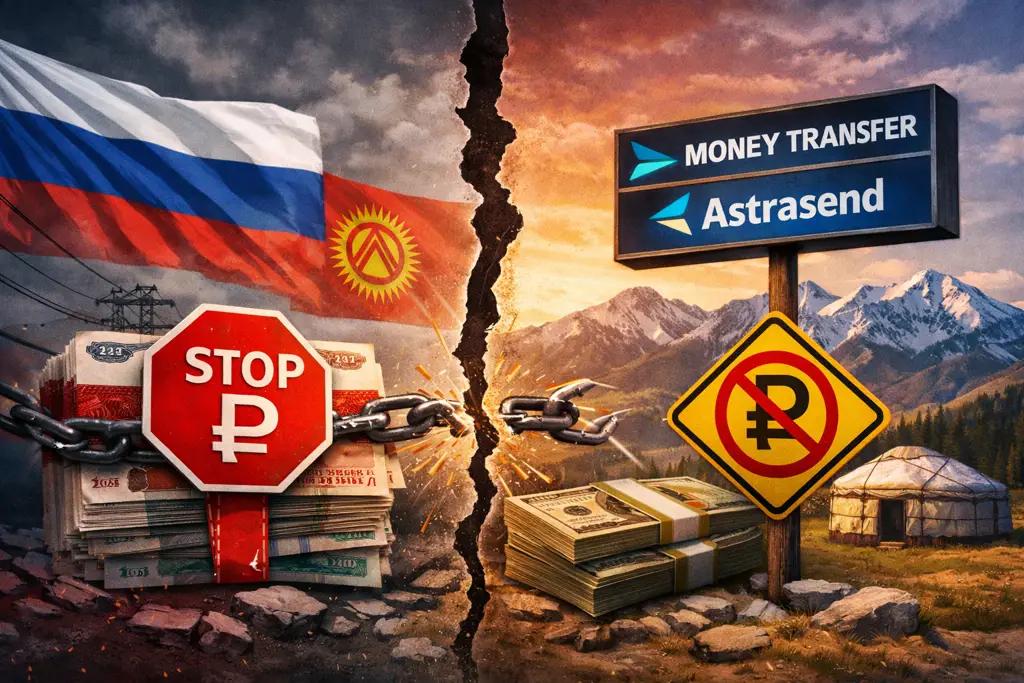
01/14/2026, 10:02From 1 January 2026, Kyrgyzstan’s largest money transfer system, Astrasend, has temporarily suspended payments of transfers in Russian rubles. This was reported by Bai-Tushum Bank, citing a notification from the system operator. Transfers in US dollars will continue to operate as usual.
The decision may appear formally technical, but in reality, it represents one of the most significant blows to cross-border financial flows between Kyrgyzstan and Russia in recent years. This is not just about the currency; it concerns the system through which more than half of all migrant remittances enter the country.
Astrasend entered the Kyrgyzstan market at the end of 2022, but within two years it managed to surpass traditional players such as Zolotaya Korona, Unistream, and Western Union.
Before Astrasend entered the market, 89.76% of all money transfers to Kyrgyzstan were processed through Zolotaya Korona, while Unistream and Western Union each held about 3% of the market. Notably, Zolotaya Korona inherited part of Western Union’s market share after the latter exited the Russian market in March 2022.
As a result, according to the National Bank, by the second quarter of 2025, the following transfers had already been processed through Astrasend:
For comparison, the total volume of incoming transfers for the quarter amounted to KGS 82 billion, with a total of 2.88 million transactions. This means that Astrasend has effectively become a systemically important financial channel for households in Kyrgyzstan.
The reason is simple: given Astrasend’s Russian registration, it has become the main infrastructure for ruble transfers from Russia, which is the source of the vast majority of remittance flows from migrant workers.
In the second quarter of last year alone, Kyrgyzstan received 2.7 million transfers in rubles, totaling RUB 64.3 billion. Compared to 2024, this represents an increase of 86.6% in the number of transfers and 59.6% in total volume. This clearly shows that rubles are the key currency for cross-border remittances.
In fact, the remittance market in our country has become ruble-centric — both in terms of infrastructure and transaction currency.
The problems began on 1 December 2025, when Astrasend announced that organizations in Kyrgyzstan were allowed to charge recipients of ruble transfers up to 1.5%. The operator stated that this was not a transfer fee, but a service charge imposed by financial institutions in the country.
However, just a few days later, the National Bank officially refuted this arrangement, announcing that “from 1 January to 31 December 2026, it is prohibited to charge any fees to recipients of international transfers if they are paid out without opening an account. This prohibition applies to all banks and payment organizations under the supervision of the country’s main financial regulator.”
This means that Astrasend’s ruble fee becomes legally prohibited under regulations starting 1 January. It is precisely from this date that the company stops payments in rubles. Formally, the suspension is described as “temporary,” but in practice it takes effect exactly when the 1.5% fee was supposed to come into force.
Perhaps there is no direct connection between these two events. However, it strongly appears that the operator is simply shutting down the segment of the market where it can no longer generate revenue.
Astrasend is not a Kyrgyz company. Its operator is the Russian bank AO “KB Sokolovsky.” For them, Kyrgyzstan is a market, but not a jurisdiction. In a situation where the country’s regulator prohibits the monetization model, it is easier to shut down the channel — especially since dollar transfers continue to operate without any changes.
To be fair, it should be noted that, at present, only Bai-Tushum Bank has officially announced the suspension of ruble transfers through the Astrasend system. However, the call center of the bank confirmed to Akchabar that the decision was made jointly with Astrasend itself. The exact timeline for resuming ruble payments is currently unknown.
One way or another, the ongoing changes in the money transfer market will inevitably have consequences. The first and most obvious of these is an increase in the cost of transfers for the population. Recipients will have to either switch to dollar transfers, which automatically entails conversion costs and exchange rate losses, or return to alternative systems where fees may be higher.
Given the scale of ruble flows, this will also have a currency impact, as large volumes of rubles will inevitably need to be converted into dollars and soms, increasing demand for foreign currency and heightening volatility in the exchange market.