

Published
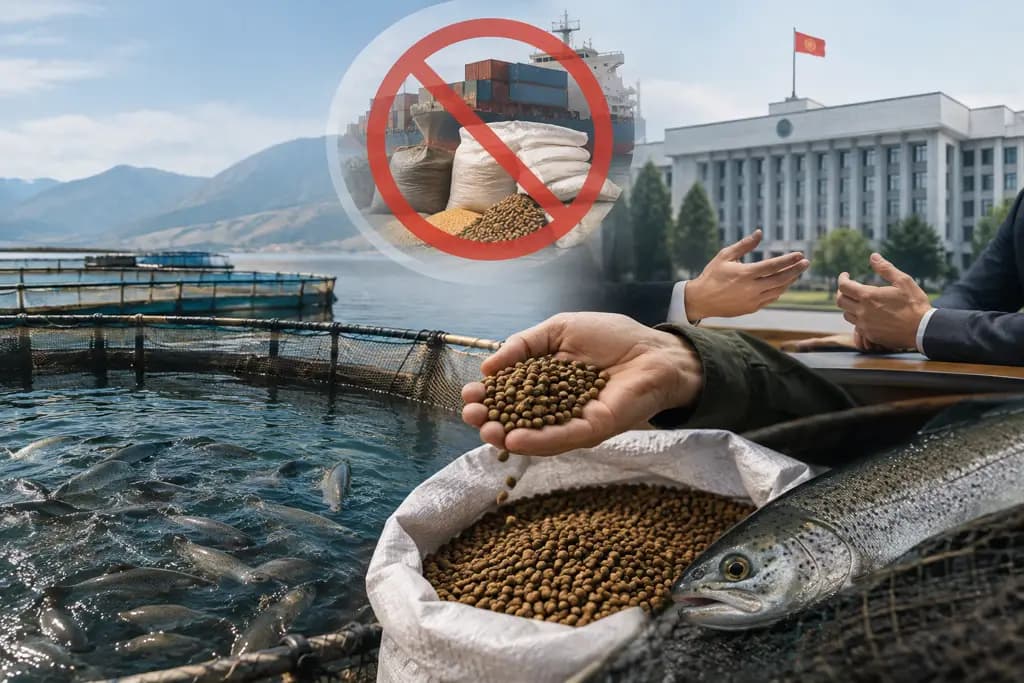
10/08/2026, 18:24In September this year, the authorities of Kyrgyzstan decided to temporarily restrict imports of fish feed in order to support local producers. Local fish farms, however, complain that the measure is hitting them financially. One farm owner, for example, linked the death of 50,000 fish to the switch to a new feed supplied by a local manufacturer.
On October 7, the restrictions on fish feed imports became the subject of a public debate between Erlis Akunbekov, the Minister of Agriculture, and popular blogger Ydyrys Isakov. The former argued that local feed producers require incentives and government support, while the latter maintained that the decision could negatively affect thousands of Kyrgyz families.
Losses resulting from the mass fish die-off at the farm were estimated at 25 million KGS. Blogger Ydyrys Isakov suggested that one possible причиной could have been the transition to a different type of feed. Fish require carefully formulated feed at every stage of development to ensure optimal growth and a product that meets market requirements. Any departure from these specifications can negatively impact production and pose serious risks to fish farming businesses.
However, the minister denies that the fish deaths were caused by the feed and argues that someone may be attempting to sabotage the decision taken by the authorities.
“We have laboratory test results. In our view, the fish died as a result of pesticide contamination. Although this has not yet been conclusively established, we believe that someone may have deliberately carried out an act of sabotage,” — the minister said.
However, the minister acknowledged that it is up to law enforcement agencies to establish the exact circumstances of the incident.
Today, Kyrgyzstan has four fish feed producers. According to Agriculture Minister Erlis Akunbekov, their combined capacity reaches 70,000 tons per year. Yet if the industry has the necessary capacity and is operating effectively, the explanation for fish farms’ reluctance to adopt domestic feed may be straightforward: the product does not fully satisfy the needs of the market. This concern was highlighted by blogger Ydyrys Isakov during the public debate.
“For example, if you own a fish farm, why would you buy imported feed if locally produced feed meets the required quality standards? If the four domestic manufacturers can provide businesses with high-quality feed, then they will not need government support. The solution is not to ban imports. The solution is to produce quality feed that the market will choose to buy on its own,” — Isakov stressed.
And Ydyrys Isakov is not the first to speak about the need for a different approach if the state intends to support domestic production. This is not a new idea. The World Bank has repeatedly recommended that developing countries promote local suppliers through access to technology, training, financing, certification, and quality improvement programs.
At the same time, import restrictions themselves are not unusual. Governments around the world employ protective measures when low-priced imports or a sudden surge in imports genuinely threaten domestic industries. The real question, however, is whether a particular measure is justified, proportionate, and designed with due consideration for the entire production chain.
If a locally produced product falls short in quality and competes primarily on price, banning imports does not address the root cause of the problem. Instead, it limits entrepreneurs’ freedom to choose the resources that best meet their needs and may ultimately raise costs for businesses throughout the production chain.
As a counterargument, the minister referred to the results of tests conducted on certain samples of imported fish feed. According to him, traces of porcine DNA were detected in the products. In Kyrgyzstan, where some consumers require food products to comply with halal standards, this is indeed a sensitive issue.
“We tested feed produced by the Polish company Aller Aqua and the Finnish company InAqua and found that they had been misleading fish farms for the past 15 years. Farmers were unaware that these feeds contained pork-derived ingredients,” — the minister said.
Isakov questioned whether this argument was sufficient and urged that religious considerations be kept separate from the issue of market regulation. He further argued that, if the presence of porcine DNA is indeed confirmed, the matter raises questions primarily about the effectiveness of state oversight and regulatory control.
In Isakov’s view, the absurdity of the ban lies partly in the fact that fish feed production in Kyrgyzstan itself remains dependent on imported inputs.
“About 95% of the ingredients used in fish feed are imported, while the final product is merely mixed in Kyrgyzstan. Are feed ingredients considered raw materials? If so, what is the difference? Why are you taking this approach?” — Ydyrys Isakov asked.
At the same time, Resolution No. 606 restricts the import of finished fish feed, while the raw materials used in its production may still be imported upon approval by the competent authorities. If the government’s objective was to help the industry develop and become more self-sufficient, it would seem more logical to start by supporting the domestic production of feed ingredients rather than focusing solely on the final product.
“Fish feed manufacturing is still a nascent industry. A single production facility costs about 500 million KGS to build. We need to offer these enterprises preferential support until they are able to stand on their own feet,” — Akunbekov said in defense of the import restrictions.
The minister also noted that fish feed costs around 200 KGS per kilogram. Given a potential production volume of 70,000 tons, the market could be worth approximately 14 KGS billion per year. From this perspective, the government does have something significant to protect. The question, however, is at what cost?
“There are about 600 fish farms in the country. Each one employs roughly five to six workers, meaning that around 3,000 people depend directly on the industry for their livelihoods. When their family members are included, government decisions in this sector affect an estimated 15,000 people,” — the blogger stressed.
In essence, Akunbekov is talking about the development potential of four feed production facilities, whereas Isakov is concerned with the livelihoods of hundreds of fish farms. By protecting domestic feed manufacturers, the government may encourage local production, investment, and future tax income. Yet if import restrictions leave fish farms without access to suitable feed, the policy could have unintended consequences: reduced fish output, large-scale fish mortality, business losses, fewer jobs, weaker export performance, and ultimately lower tax revenues. The challenge for policymakers is to ensure that support for one segment of the industry does not come at the expense of the sector as a whole.