

Published
02/05/2026, 11:19In recent years, international sanctions and tighter export controls have radically changed the daily operations of Kyrgyz businesses. Companies that until recently could freely work with partners from different countries are now forced to prove the origin not only of goods but also of every som or dollar transferred.
Sanctions compliance has evolved from a formal requirement into a key factor for access to banking operations, credit, and international markets. For many entrepreneurs, it has become the new reality.
Banks have become the primary enforcers of the new regulations. It is through the financial sector that most checks are carried out: client due diligence, supply chain analysis, examination of transaction structures, and identification of ultimate recipients of funds.
Today, banks request extended document packages, including contracts, invoices, waybills, certificates of origin, and detailed explanations for every large transfer. As a result, businesses find themselves in a constant mode of proving their integrity.
Compliance is no longer just a task for lawyers. It now involves accounting, logistics, sales, and procurement. An error in documentation or an imprecise formulation can lead to payment freezes or refusal of service.
In the trade sector, these changes have manifested as strict documentation of supply chains and formalization of contracts. Companies are forced to collect evidence of the origin of goods and their movement routes in advance.
As Gulnara Uskenbaeva, head of the Suppliers Association, notes, this is more about increasing paperwork than introducing new business processes.
“Contract, payment, and product quality control existed before. Especially in the food sector. Today, the focus has simply intensified on providing documentary proof of already established practices,” — says Uskenbayeva.
Sanctions have hit logistics the hardest. Delivery times have increased, costs have risen, visa requirements for drivers have become stricter, and the number of accompanying documents has grown significantly.
According to Meerim Usubalieva, Director of AVTO Caravan Logistics, additional checks have become part of everyday operations.
“Shipments are being checked more frequently, the number of documents has increased, and costs are rising. No one compensates for them — everything is automatically built into the rates,” — emphasizes Meerim Usubalieva.
International payments have become a separate issue. Transfers in dollars, euros, and other currencies are increasingly delayed. Banks require additional explanations, verify the origin of funds, and sometimes suspend transactions indefinitely.
“Sometimes the money simply gets stuck. This creates cash flow gaps and increases costs,” — continues Usubalieva.
To reduce risks, companies split their transactions across several banks: one for ruble operations, another for Europe, and a third for the USA.
“Businesses have to maintain accounts in three to four banks. This means constant transfers, currency conversions, and lost time. Simple operations now stretch over days,” — confirms the head of the Suppliers Association.
The main challenge of sanctions compliance lies in the requirement to “clean” financial flows of Russian origin. Companies are forced to prove that the funds sent to Western partners are not linked to Russia.
In practice, this turns into an almost impossible task.
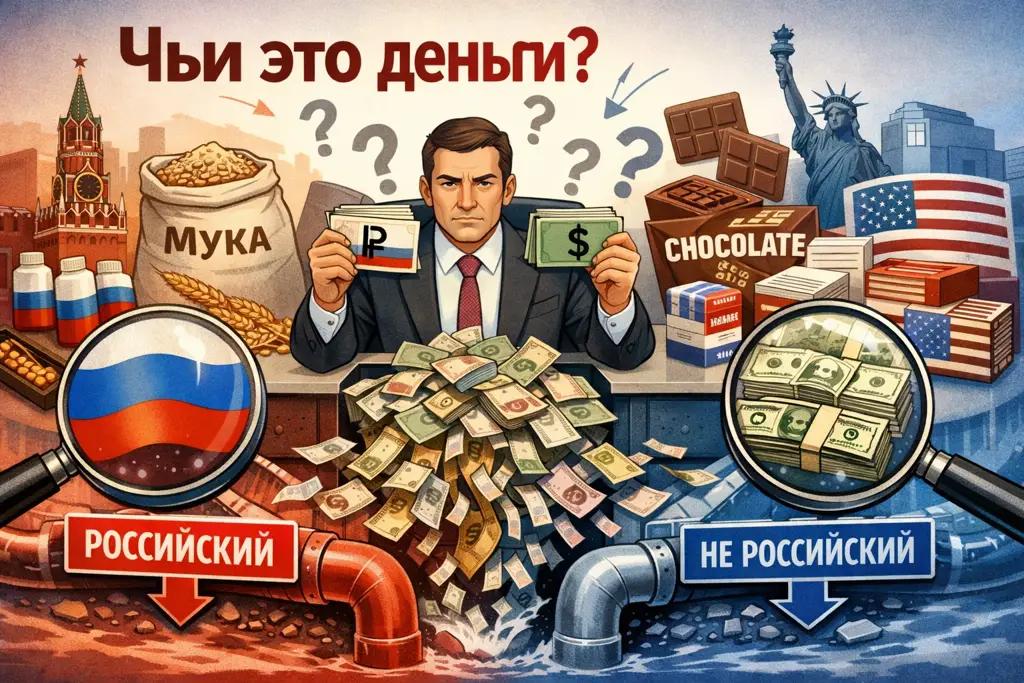
“In reality, this often seems absurd: a supplier simultaneously sells Russian flour and, say, American chocolate, receives revenue from thousands of retail outlets, and then has to explain to the bank which specific soms or dollars from this combined flow are considered ‘Russian’ and which are ‘non-Russian,’” — says Gulnara Uskenbaeva.
In fact, businesses are being asked to artificially separate a single turnover that, in real-world trade, has long existed as an integrated financial flow. Money from different products mixes in cash registers, accounts, and settlements — and it is impossible to retroactively separate it “by origin” without formal schemes and additional reporting.
Despite all the challenges, the market acknowledges that stricter compliance increases transparency, discipline, and management quality. Companies become more structured and reduce reputational and operational risks.
Those who invested in accounting, analytics, and supply chain control in advance adapt more quickly.
Sanctions compliance is becoming part of business as usual — a kind of insurance against payment freezes, refusals, and reputational losses. Companies are gradually shifting from reacting to banks’ requests to systematic preparation, including pre-screening partners, standardizing documents, and establishing internal regulations.
Still, there remains a sense that global rules are being implemented too mechanically, without regard for regional specifics and the structure of Central Asia’s economy. For example, Kyrgyzstan is a market dominated by small and medium-sized companies, which often lack the extra resources to create dedicated compliance departments. As a result, the new requirements fall on existing teams.