

Published
08/17/2026, 17:07On August 14, several Central Asian countries experienced power supply disruptions. In Almaty, the metro stopped operating, and problems arose with traffic lights and public infrastructure. Outages were also recorded in Kyrgyzstan, Uzbekistan, and Tajikistan.
Over the past one and a half years, 26 emergency shutdowns of high-voltage power lines have been recorded in Kyrgyzstan. This was reported by Chairman of the Cabinet of Ministers Adylbek Kasymaliev at a staff meeting.
According to him, the causes of the failures include violations of equipment operation and safety rules, unsatisfactory technical condition of the networks, breaks and damage to power transmission lines — including those caused by contracting organizations — as well as improper performance of duties by responsible officials.
The Head of the Cabinet noted that each unscheduled outage not only causes public dissatisfaction but also harms businesses.
In this context, the incident of August 14 will be studied separately. Kasymaliev instructed the establishment of a special commission to determine the causes of the power outage in several regions, including identifying the circumstances of the latest major disruption.
Following the inspection, it was instructed to provide a legal and disciplinary assessment of the actions of responsible officials from energy agencies, companies, and contracting organizations, should their fault be established.
Thus, the issue of power supply reliability for Kyrgyzstan consists of two parts. The first is related to the regional energy system, where a failure in one part of the grid can affect neighboring countries. The second concerns the state of the domestic infrastructure, the operation of equipment, and the occurrence of accidents within the country.
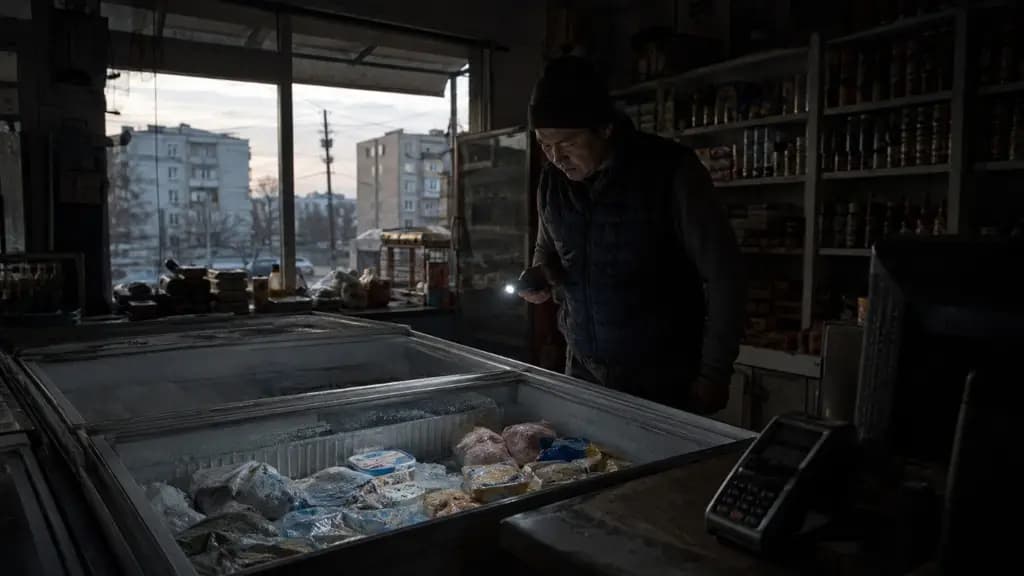
For a small grocery store in the suburbs of Bishkek, the main problem during a power outage is refrigerators and freezers. When the electricity goes out, employees cover the freezers with blankets and try not to open them unnecessarily. Frozen products are temporarily withdrawn from sale, since it is unclear how much they may have warmed up.
''We can eat the ice cream ourselves or give it away for free,'' — says a store employee.
During one of the outages, losses from ice cream alone could amount to 2,000–3,000 KGS. Another 1,000–2,000 KGS could be lost from other frozen products.
Frozen dumplings and other dough-based products are particularly problematic. If the goods have thawed, it becomes noticeable from the packaging and their shape. After being refrozen, they can no longer be sold.
For the store, this means a double loss: first, the entrepreneur paid the supplier for the goods, and then was unable to generate revenue from them. The supplier, meanwhile, does not always accept such products back, since the cause of spoilage was the absence of electricity at the retail outlet itself.
Store representatives say that they have become more cautious about purchasing frozen products. As a result, the store sells less, the supplier receives smaller orders, and customers face a reduced selection. Thus, the damage from unstable power supply arises even during the hours when electricity is available.
For a restaurant, a power outage can be significantly more costly.
The kitchen, refrigerators, ventilation system, cash registers, terminals, and delivery services all depend on electricity. If at 7:00 p.m. a restaurant expected to serve 30 customers, but due to the outage they went to another establishment, the lost revenue cannot be recovered once power is restored. This is why the cost of downtime can be several times higher than the cost of the electricity the restaurant would have consumed during that hour.
This risk was particularly evident in Almaty. During the latest blackout, the city had been expecting an additional influx of visitors due to the Kanye West concert, which was eventually postponed to the following day. For restaurants, cafés, taxis, hotels, and shops, this meant a day of potentially increased demand. Any prolonged disruption at such a moment multiplies the cost of downtime.
The most obvious way to protect against such losses is a backup power source.
In Bishkek, a gasoline generator with a capacity of about 5 kW can be found for roughly 40,000–70,000 KGS, while 7 kW models cost around 60,000–85,000 KGS.
For a small grocery store, such a unit can ensure the operation of refrigerators, freezers, lighting, and cash register equipment. However, the required capacity depends on the number of appliances and their starting characteristics.
Therefore, it cannot be assumed by default that a 5 kW generator will be sufficient for every shop. Refrigeration units can draw considerably higher power during startup. Hence, for multiple refrigerators and freezers, a 7 kW generator may be the more practical choice, despite comparatively moderate average consumption.
To the cost of the equipment itself are added installation, maintenance, fuel, and, if necessary, an automatic transfer switch system.
For a small store, a 5–7 kW generator may turn out to be cheaper than regular downtime. With fuel consumption of about 1.5–2.5 liters of gasoline per hour, operating the unit costs roughly 110–190 KGS in fuel alone. If, during several hours of outage, the store loses thousands of soms in goods and revenue, backup power becomes economically justified. However, with rare interruptions, purchasing a generator for tens of thousands of soms may, on the contrary, prove uneconomical.
The blackout also revealed another problem — the vulnerability of Central Asia’s interconnected power system.
The power systems of the countries in the region are interconnected. Under normal conditions, this is an advantage: countries can exchange electricity, offset capacity shortages, and make more efficient use of their own generating resources. Yet such a system also has a downside. If a serious imbalance occurs, the consequences may spread beyond the borders of the country where the problem originated.
It was precisely such a chain of events that the parties described differently. Kazakhstan’s system operator KEGOC reported that on August 14 at 14:37, two hydro generators with a total capacity of 600 MW at the Toktogul Hydropower Plant in Kyrgyzstan were shut down in an emergency. According to KEGOC, this caused a sharp change in power flows and an overload of the North–East–South transit. After that, the emergency protection system was triggered, and the Southern zone of Kazakhstan was separated from the unified power system.
Our Ministry of Energy described the sequence differently. According to its data, at 15:34, following the external disconnection of a high-voltage line in Kazakhstan, the Unified Power System of Central Asia switched to an isolated mode, after which Kyrgyzstan’s power system also temporarily began operating independently.
But for consumers, the outcome was the same: several countries immediately felt the disruptions.
In Kazakhstan, the technical failure led to the shutdown of three 500 kV transmission lines. In Almaty and the surrounding region, the volume of disconnected load amounted to about 300 MW. At 15:11, the Almaty metro stopped operating. However, station lighting and ventilation continued to function thanks to backup batteries. Problems also arose with traffic lights and road traffic. "Almaty Su" warned of possible disruptions in the operation of pumping stations.
Disruptions were recorded in Kyrgyzstan, including in Bishkek and Chuy province, as well as in Uzbekistan and Tajikistan.
For the ordinary consumer, all of this looked the same — the lights went out. But the economic consequences were different for each.
For a metro passenger, it meant lost time. For a restaurant —lost orders. For a store — spoiled goods. For a factory — a halted production line. And for power engineers — the need to stabilize the entire system.
That is why the cost of a blackout cannot be measured by a single figure. Yet the situation demonstrated that the issue of power supply reliability goes far beyond the energy sector. The interconnected power system of Central Asia provides countries with an important advantage: the ability to exchange capacity and support one another. At the same time, however, a major failure can trigger a chain reaction, the consequences of which are felt by consumers and businesses across the region.