

Published
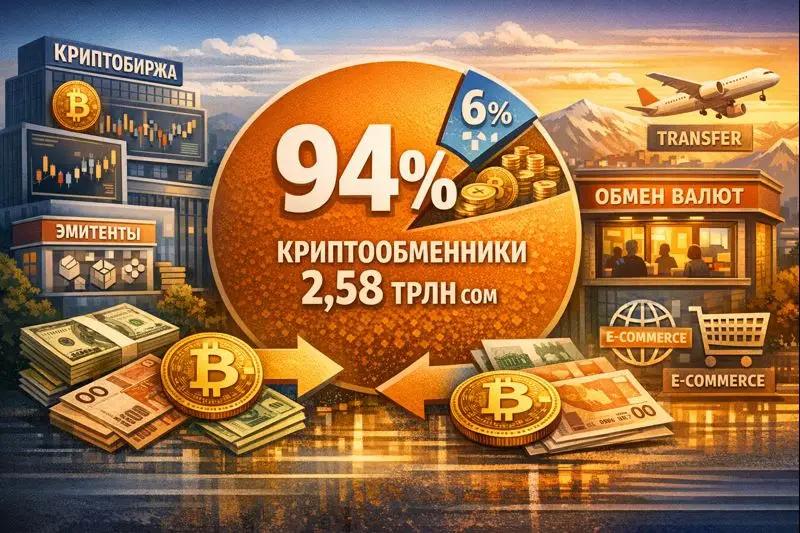
02/11/2026, 13:52Despite its rapid growth and trillion-level turnover, the virtual assets market in Kyrgyzstan remains primarily a platform for exchange operations. According to the Financial Supervision Authority, more than 94% of all transactions in the sector are handled by exchange operators, while crypto exchanges and issuers play a secondary role.
In practice, a model has emerged in which digital assets are used primarily as a tool for conversion and transfers, rather than as an object of long-term investment.
In 2022, the virtual assets market was in its infancy. There were only six exchange operators, one crypto exchange, and two miners. Following the introduction of licensing in 2023, the number of exchange operators increased to 60, and by 2025 — to 82.
The exchange segment, meanwhile, developed at a noticeably slower pace. The number of crypto exchanges increased from one to five over four years. Thus, the market’s expansion occurred almost exclusively through exchange services.
By the end of 2025, the total turnover of Virtual Asset Service Providers (VASPs) reached 2.73 trillion KGS across 2.12 million transactions. Of this amount, 2.58 trillion KGS was generated by crypto exchange services.
For comparison, the turnover of crypto exchanges amounted to only 157 billion KGS — less than 6% of the market. In other words, the vast majority of the country’s crypto economy operates not through trading platforms, but through fast-exchange services. This structure is typical for markets where virtual assets are primarily used for:
The investment function of cryptocurrencies remains secondary in this context.
Despite the rapid growth in the number of transactions, the VASPs virtual assets market in Kyrgyzstan is characterized by high volatility in average transaction size. In 2022, with a limited number of transactions, the average transaction volume exceeded 568,000 KGS, reflecting mainly large and sporadic deals. In 2023, against the backdrop of the launch of licensing and an influx of new participants, this figure surged to over 10.5 million KGS, indicating the dominance of large corporate and wholesale operations at the early stage of market legalization. In 2024, as user participation became more widespread, the average transaction size decreased. By 2025, the average volume of a single transaction in the crypto sector amounted to 1.29 million KGS.
In 2025, crypto exchanges accounted for 23.3 thousand transactions — compared to over 2 million by exchange service operators. In other words, a mass culture of crypto trading has yet to develop in Kyrgyzstan.
As a result, domestic exchanges remain a niche product, failing to form an independent market.
At the same time, the average volume of a single transaction on crypto exchanges in 2025 amounted to 6.76 million KGS, whereas on crypto exchange services it was 1.23 million KGS.
The fiscal impact of the crypto market is also primarily generated through exchange operations. In 2025, professional participants in the cryptocurrency market contributed 5.5 billion KGS to the state budget, compared to 73 million KGS in 2022.
The growth in tax revenues is primarily correlated with the expansion of the network of exchange operators.
The segment of virtual asset issuance remains limited. The registry records only six issuances with a total value of around 3 billion KGS. For the majority of market participants, token issuance is not a priority area.
Earlier, Akchabar reported that, as of early September last year, Kyrgyzstan’s portfolio included five domestic cryptocurrencies: a token from LLC “MTN,” the stablecoin “A7A5,” CDSD issued by LLC “Zolotoy Som,” KGST, and the digital token LMAu. The sixth was the Ministry of Finance's USDKG.
As the market grew, oversight also intensified. Between 2023 and 2025, the number of violation protocols tripled, and dozens of licenses were revoked. According to data from the crypto monitoring platform RUNEX.KG, as well as an analysis of market participants’ reports, a range of violations was identified, leading to:
In addition, licenses were revoked for 26 virtual asset service providers, the activities of three others were temporarily suspended, and certificates of activity were annulled for four mining companies.
The results of 2025 show that a “practical-type” crypto market has taken shape in Kyrgyzstan. Its core consists of exchange services that handle the flow of funds both within the country and beyond. At the same time, crypto exchanges, issuance, and investment products have not yet become the foundation of the sector. Thus, today, virtual assets in the national economy primarily serve as an alternative payment and exchange instrument.