

Published
05/01/2026, 13:03As of May 1, the United Arab Emirates has officially withdrawn from the OPEC+ agreement, shifting to an independent oil production policy. The decision by one of the world’s largest oil producers may increase volatility in the global market, although its actual consequences remain uncertain for now.
The United Arab Emirates announced its intention to leave the alliance on April 28 — just days before the OPEC+ meeting scheduled for May 3. The country had been a member of the organization since 1967.
“The UAE’s decision to withdraw from OPEC+ reflects a policy shift driven by long-term market trends. We thank OPEC and its member states for many years of constructive cooperation. We remain committed to ensuring energy security through the supply of reliable, environmentally responsible, and low-carbon products, as well as to supporting the stability of global markets,” — the statement said.
According to data as of February 2026, oil production in the United Arab Emirates amounted to 3.6 million barrels per day, accounting for more than 12% of total OPEC output. Previously, Qatar and Angola had also left OPEC, although the organization continued to function without serious consequences.
At the same time, the situation in the Middle East remains a more significant factor at present. In particular, risks related to the Strait of Hormuz — one of the key routes for global oil and petroleum product shipments — are already having a direct impact on global trade flows and prices.
According to Kanat Eshatov, President of the Oil Traders Association of Kyrgyzstan, the UAE’s withdrawal alone is unlikely to lead to immediate changes. Rather, it represents an additional factor of uncertainty, the consequences of which are expected to emerge gradually.
“It is still premature to speak about the consequences of the UAE’s possible withdrawal from OPEC. Despite the country’s significance within OPEC and OPEC+, no sharp changes are expected in the short term. However, the very fact of such a move could trigger transformations within the organization,” — said Kanat Eshatov.
The expert does not rule out the possibility that other countries may follow this example. At the same time, he emphasizes that the petroleum products market remains volatile overall, and the real consequences will become clear only over time, as the balance within OPEC and OPEC+ evolves.
According to the President of the Oil Traders Association of Kyrgyzstan, there is no fuel shortage on the domestic market of Kyrgyzstan — supplies continue uninterrupted, but the key question is at what price. The most challenging situation is currently developing in the diesel fuel segment.
According to official statistics, fuel prices increased across all major fuel types between April 1 and 29. The price of AI-92 gasoline rose the least, by 4.6%, while diesel fuel recorded the largest increase, up 11.1%. The price of AI-95 gasoline increased by nearly 5%.
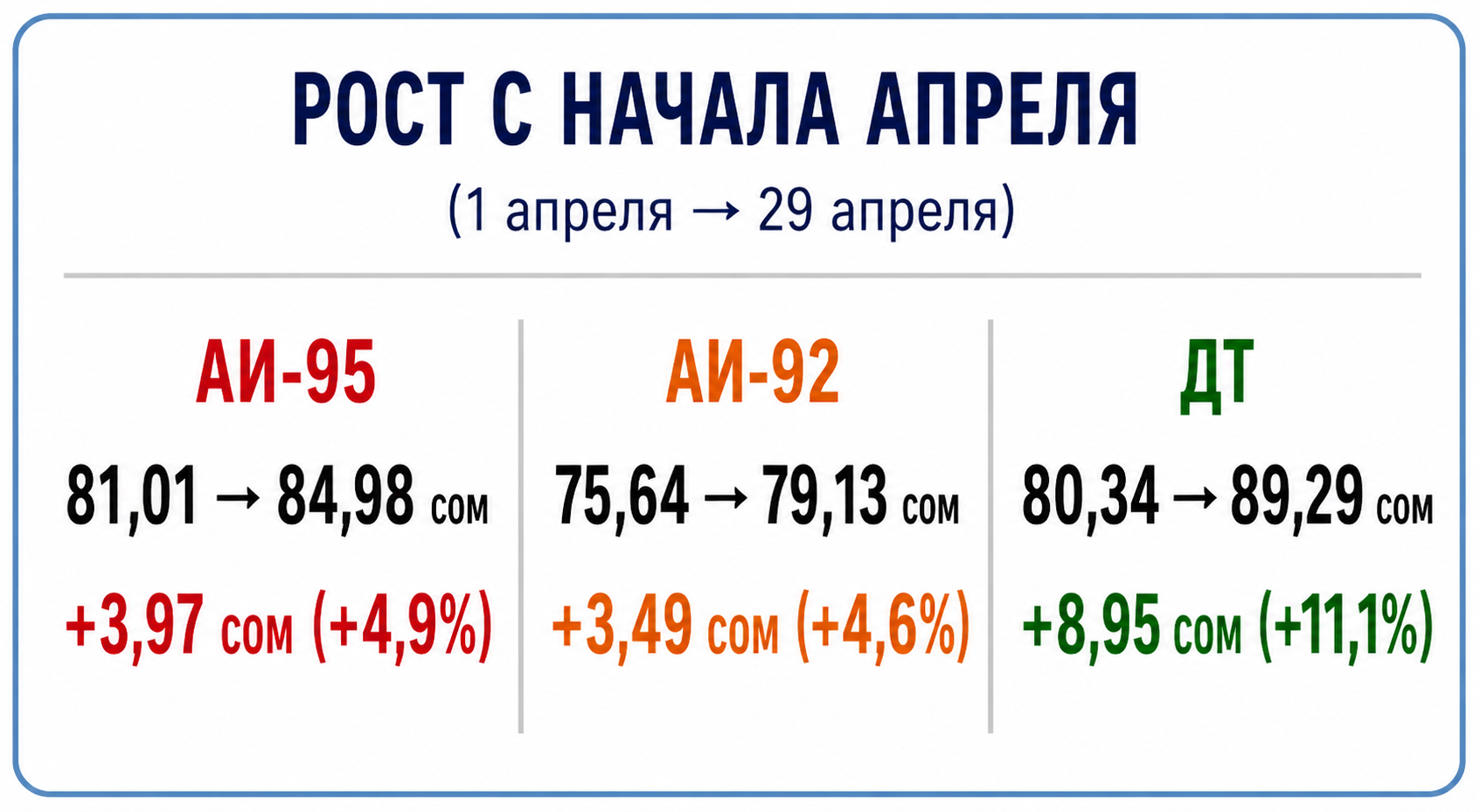
Thus, diesel fuel became the main driver of price growth.
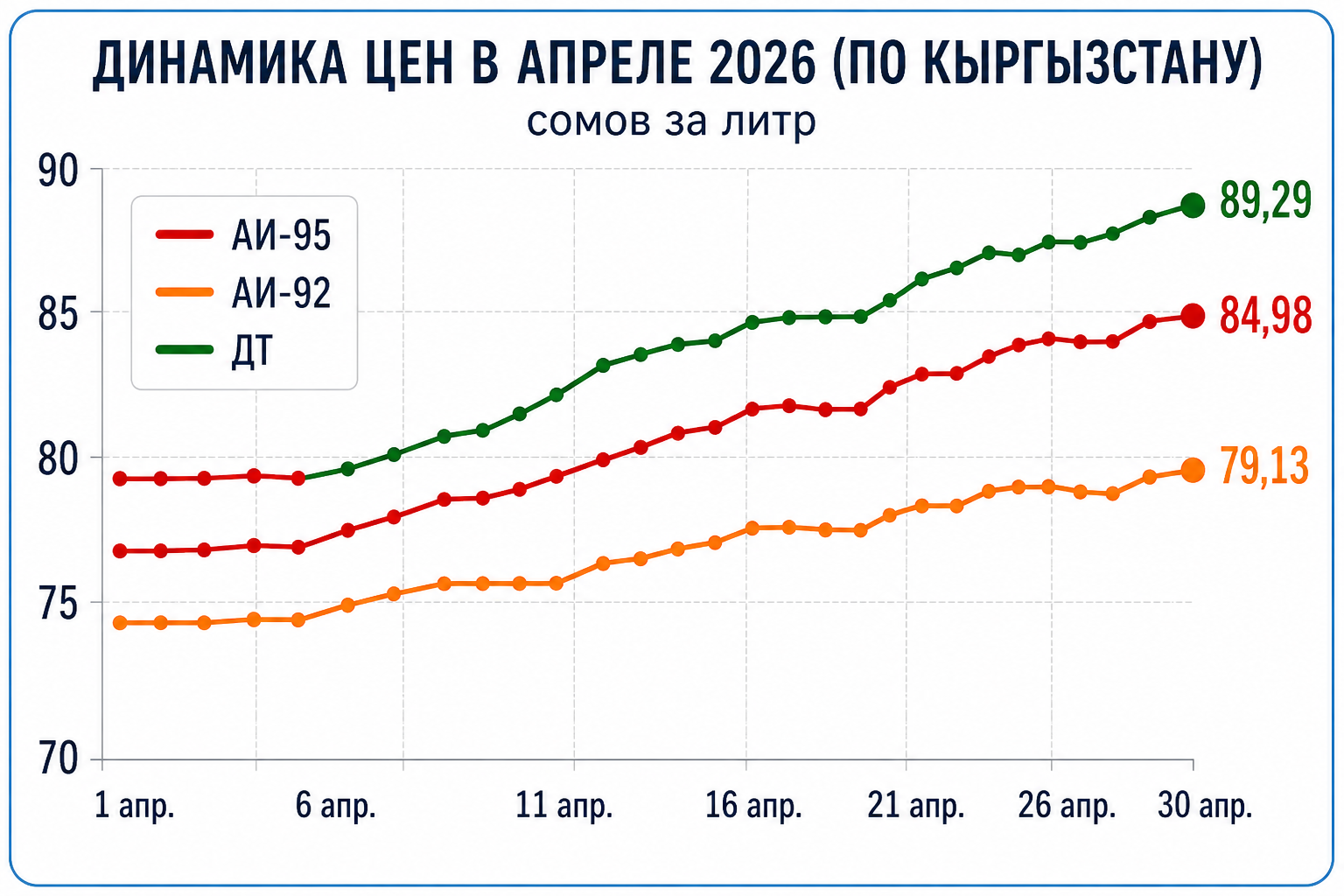
The current rise in fuel prices in Kyrgyzstan is linked to the situation unfolding on the global fuel market. One of the key factors remains the tension surrounding the Strait of Hormuz — one of the world’s most important oil supply routes. Problems in the region have led to a redistribution of fuel flows.
As a result, demand for alternative supplies has increased. This has intensified competition for Russian petroleum products, leading to higher refinery purchase prices for importers, including Kyrgyzstan.
“Major economies such as China, Japan, South Korea, India and others are actively increasing their purchases from Russia. This is driving prices upward. Additional pressure is being created by the situation within Russia itself. Some oil refineries are undergoing scheduled maintenance, while certain facilities have been subject to attacks, causing disruptions and localized shortages. As a result, supply volumes are decreasing and prices are rising,” — explains Kanat Eshatov.
Additional pressure is created by the fact that Kyrgyzstan is an agrarian country, where demand for diesel fuel remains consistently high almost throughout the entire year.
“The purchase price of diesel fuel has already increased by more than twofold. If the current dynamics persist, retail diesel prices could reach around 103 KGS per liter and continue to rise,” — says the expert.
Despite the rise in procurement prices, companies on the domestic market are trying to avoid sharp increases in fuel costs. Price adjustments are being made gradually, using previously accumulated stock reserves.
“In contrast to a number of countries where fuel prices are adjusted quickly in line with the market, for example in Uzbekistan, in Kyrgyzstan the increase is gradual. Thanks to previously purchased volumes, oil traders are maintaining fuel affordability,” — emphasizes the President of the Oil Traders Association.
At present, negotiations are underway with government authorities on possible support measures. Among the options being discussed are tax reliefs, which could reduce prices by up to 13 KGS for gasoline and 8–9 KGS for diesel. Subsidies or preferential lending schemes for fuel procurement are also being considered.
However, no concrete decisions have been made at this stage. Therefore, the market situation remains tense. Prices continue to rise, while the possibilities for containing them are limited.