

Published
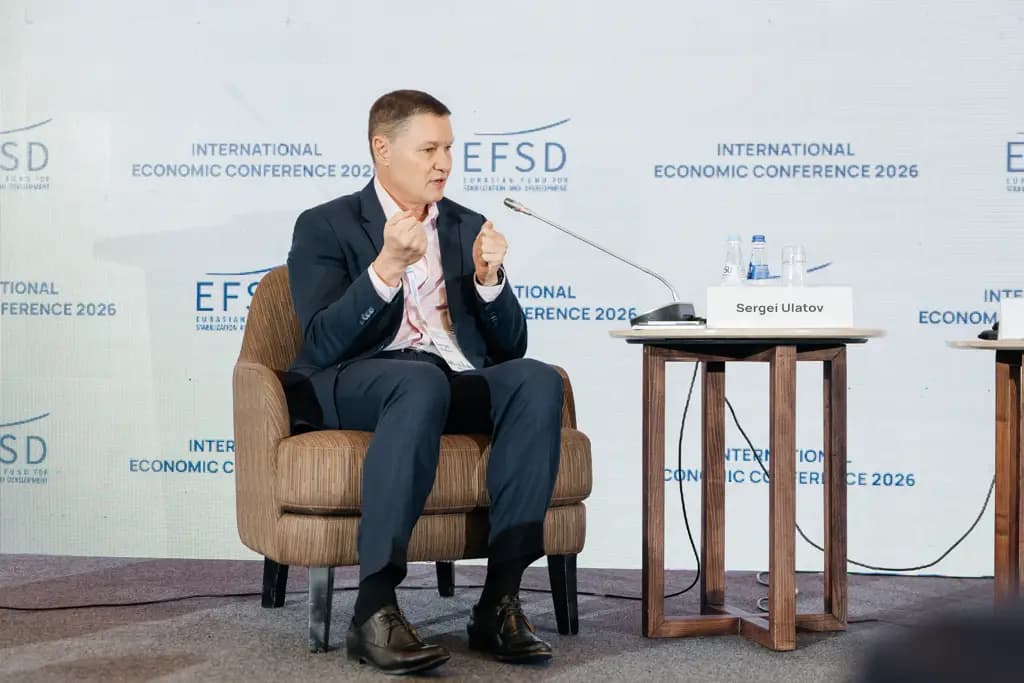
10/29/2026, 17:52Governments’ efforts to ensure high GDP growth rates by increasing public investment may pose long-term risks to the economy. Despite a relatively stable macroeconomic situation, the nature of the investment policies of Kyrgyzstan, Kazakhstan, and other countries in the region is a cause for concern for the Eurasian Fund for Stabilization and Development. Sergey Ulatov, the Fund’s chief economist, made this statement at the International Economic Conference in Astana.
According to him, in recent years, countries in the region have been increasingly using budgetary tools to stimulate investment. While this helps accelerate economic growth in the short term, it does not guarantee an increase in productive capacity in the future.
“From our perspective, this is a rather dangerous game. We are becoming concerned about the nature of government investments in virtually all countries in the region—in Kazakhstan, Kyrgyzstan, and even in the Russian Federation,” Ulatov noted.
The economist explained that, at first glance, increasing government spending seems like the right decision, as new facilities are being built, investment demand is growing, and economic activity is rising. However, the key question is how productive these expenditures will ultimately prove to be.
In his assessment, the results of some investments can only be objectively evaluated years later.
“Perhaps only in ten years will the economy show just how productive they turned out to be,” said the EFSD’s chief economist.
At the same time, ineffective investments may not only fail to deliver the expected growth but also become a financial burden for future generations.
Ulatov emphasized that this is precisely why, when financing projects, the EFSD pays particular attention to their quality, long-term impact on the economy, and macroeconomic stability.
Responding to a question from journalists about what governments should focus their economic policies on if increased investment does not guarantee sustainable development, Ulatov expressed an opinion that, he said, often draws criticism from government agencies.
“Economic growth in and of itself, if it becomes the sole political KPI, is a very bad idea,” he said.
According to the economist, when a government sets itself the goal of achieving high GDP growth rates at any cost, there is a temptation to take the easiest route—increasing domestic demand through investment.
This approach can indeed deliver quick results in economic statistics. However, growth in current expenditures and construction volumes does not necessarily mean that the economy is becoming more productive or will be able to sustain the achieved growth rates in the future.
“If you set a goal of achieving high growth rates at any cost, you will most likely take the easiest path,” Ulatov explained.
At the same time, the EFSD’s chief economist emphasized that this does not mean there is a need to cut government investment per se.
According to him, countries in the region still require significant investment in public infrastructure. In particular, there remains a need to build roads, expand access to electricity and water, and modernize facilities inherited from the Soviet era.
Such investments can remove constraints on economic development. However, their effectiveness must be assessed based on long-term results, not just on their immediate contribution to GDP growth.
Ulatov also noted that the current macroeconomic situation in the region’s countries appears relatively stable.
In his assessment, public debt remains generally under control, and central banks are gradually managing inflationary pressures, despite lingering risks.
However, long-term structural imbalances continue to lurk beneath this stability. Moreover, the resilience of the economies in recent years is largely attributable to a favorable combination of external circumstances.
“The external environment has been more favorable than unfavorable for our countries,” the economist noted.
According to him, commodity prices and shifts in international trade flows have had a positive impact on the region’s economies. As a result, these factors partially offset the negative consequences of external shocks.
However, it is not worth counting on such conditions to persist for long.
Ulatov emphasized that countries need to address structural problems right now—problems that do not disappear even amid high growth rates.
One such problem is the inefficient use of the labor force and human capital. EFSD research shows that countries in the region have significant labor resources, the potential of which has not yet been fully realized.