

Published
11/24/2026, 11:31Kyrgyzstan is entering a period in which the key challenge for economic policy is not so much maintaining high growth rates as combining them with price stability.
By the end of 2026, the country’s real GDP is expected to grow by 8.7 per cent, according to the Ministry of Finance, whilst inflation is set to reach 11 per cent. As early as 2027, the government expects to reverse this trend. The economy is projected to grow by 8.3 per cent, whilst the rate of consumer price inflation is expected to slow to 7.5 per cent.
The forecast for 2028 appears to be the most ambitious. It envisages economic growth accelerating to 10.4 per cent whilst inflation falls to 6.6 per cent. In 2029, these figures will stand at 7.4 per cent and 6.2 per cent respectively.
The authorities therefore expect to achieve disinflation without any significant loss of economic momentum.
This scenario is underpinned by high growth rates in the construction and services sectors, and, in 2028, in industry as well, whose value added is forecast to increase by 18.8 per cent.
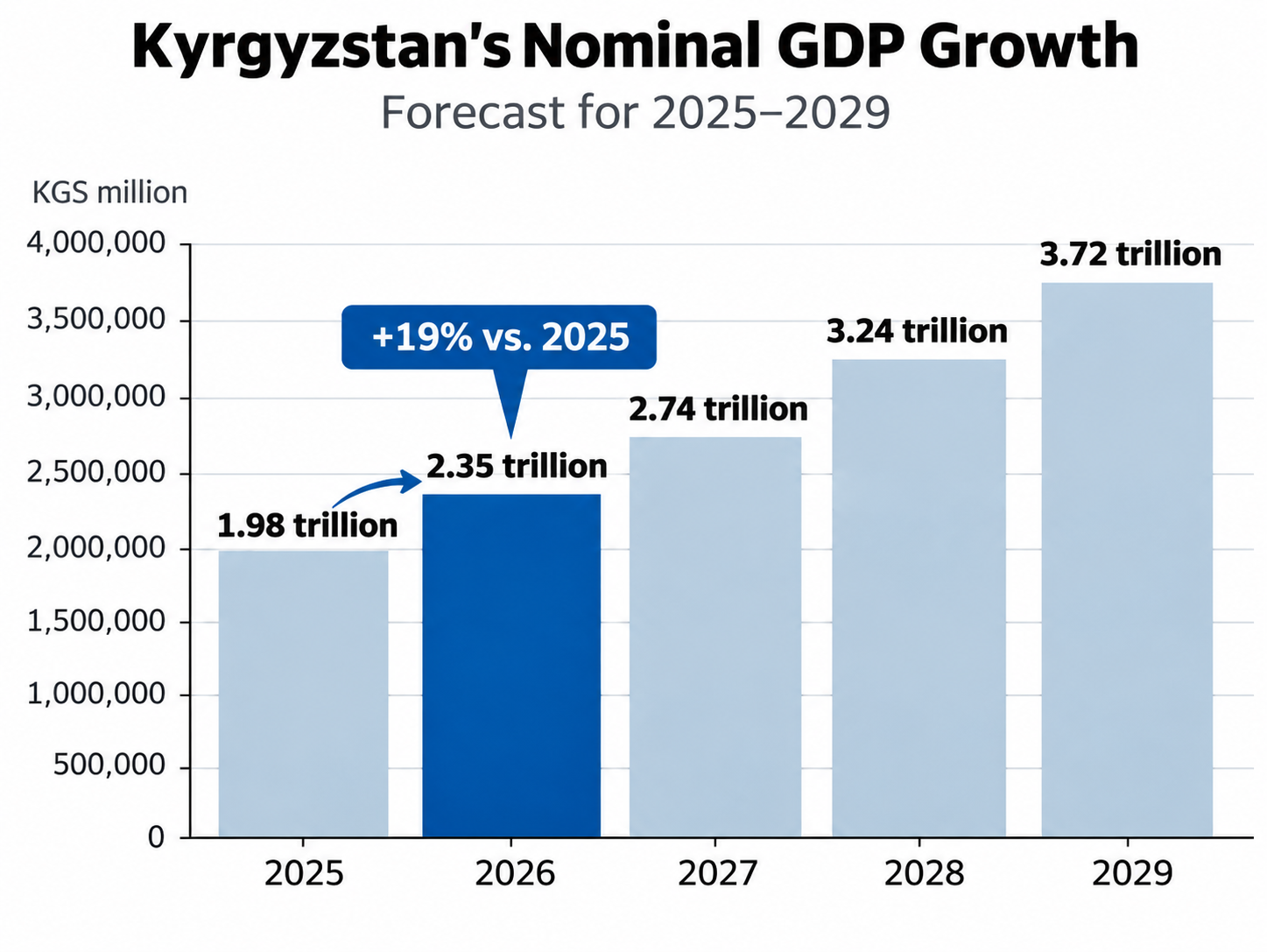
By 2029, Kyrgyzstan’s nominal GDP is expected to reach 3.72 trillion KGS, compared with an expected 2.35 trillion KGS by the end of 2026.
However, what is of fundamental importance is not so much the scale of the economy’s expansion in monetary terms as the sustainability of real growth. The main challenge lies in ensuring rapid economic growth without allowing it to become a source of additional inflationary pressure.