

Published
09/23/2026, 11:21The news about the annulment of Zolotaya Korona's registration in Kyrgyzstan quickly turned into headlines about the system’s alleged ban. Formally, this is not the case. Yet to regard the development as merely a technical change would also be a mistake, explains the expert and author of the article, — Aleksey Veretenov.
On September 17, the National Bank of the Kyrgyz Republic annulled the registration of "Zolotaya Korona" as an international electronic money system. Notably, this was done at the request of the operator itself — RNKO "Payment Center".
At the same time, in the register of international money transfer system operators published by the National Bank of the Kyrgyz Republic on September 8, "Zolotaya Korona" is listed separately under registration number 1013041214. The decision of September 17 was entered into another register — that of international electronic money systems. Therefore, these two registration statuses should not be conflated.
Therefore, based on the decision of September 17, it would be incorrect to claim that Kyrgyzstan has completely banned "Zolotaya Korona".
The real issue today lies not so much in the system’s formal status, but rather in how economically viable it is for banks to continue working with it.
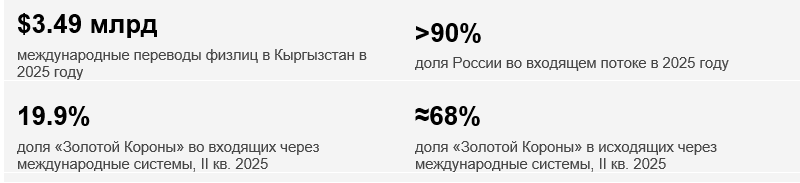
Remittances remain a significant element of the country’s economy. In 2025, the volume of international money transfers by individuals to Kyrgyzstan amounted to about 3.49 billion USD, of which approximately 3.23 billion USD came from Russia. In other words, the Russian corridor accounted for more than 90% of the incoming flow.
It is important here not to mix two different statistical bases. Since 2024, the National Bank of the Kyrgyz Republic has included in the overall statistics of international transfers by individuals not only traditional money transfer systems, but also transactions through banking applications, cards, and e‑wallets. Therefore, the figure of 3.49 billion USD reflects the overall scale of cross‑border transfers for the country’s economy, but it is not a basis for calculating the share of "Zolotaya Korona" specifically.
To assess the system’s position itself, one needs to look at a narrower segment — international money transfer systems. And here the picture becomes particularly interesting.
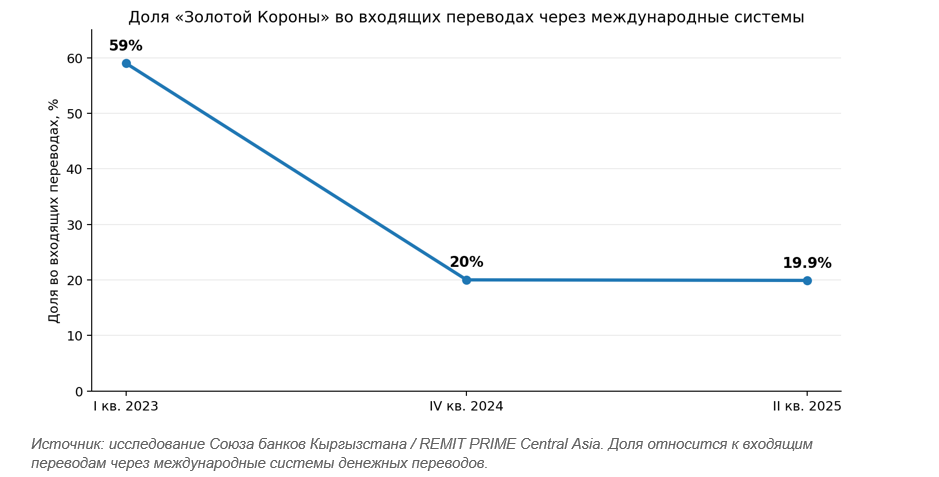
Sanctions overlapped with a market that was already undergoing active change. According to an industry study by the Union of Banks of Kyrgyzstan, Zolotaya Korona’s share of incoming transfers through international systems fell from 59% in the first quarter of 2023 to about 20% by the end of 2024 and in the second quarter of 2025.
By mid‑2025, Astrasend had already become the leader. At the same time, Zolotaya Korona’s business in absolute terms had not yet declined: in the second quarter of 2024, 14.17 billion KGS were transferred through the system, and a year later the figure had risen to 16.29 billion KGS.
In other words, "Zolotaya Korona" was losing not so much the absolute volume of business as its market share: its flow continued to grow, but competitors were expanding much faster. The July sanctions were imposed at a time when the system was already losing its former dominance, yet still maintained a significant volume of operations.
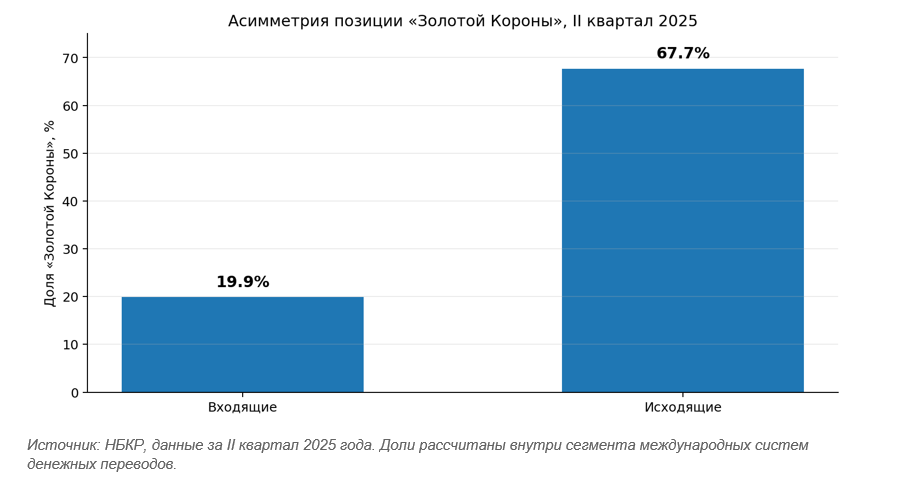
Even more interesting is the difference between the two directions of transfers. In the second quarter of 2025, about 82.5 billion KGS flowed into Kyrgyzstan through international systems. Of this, 16.3 billion went through "Zolotaya Korona" — just under 20%.
But in the outbound direction the picture was completely different. Of the 13.64 billion KGS sent from Kyrgyzstan through international systems, 9.23 billion went via "Zolotaya Korona". That is nearly 68% of the entire outgoing volume.
For someone receiving money in Kyrgyzstan, "Zolotaya Korona" is no longer the dominant channel for inbound transfers, as alternative systems are available in the market. This creates conditions for further redistribution of the flow. For someone sending money from Kyrgyzstan, however, the restructuring is potentially more noticeable: according to Q2 2025 data, "Zolotaya Korona" held a very large share of the international systems segment.
In the register published by the National Bank of the Kyrgyz Republic on September 8, 20 international money transfer systems are listed. Among them are MoneyGram, Ria Money Transfer, UPT, Western Union, Astrasend, Unistream, Quickpay, BEST, and others.
But the presence of twenty systems does not mean twenty identical products. For the client, the specific corridor matters: whether money can be sent from Russia or to Russia, which currency is available, where cash can be collected, whether the transfer can be credited directly to a card, and what the exchange rate and commission will be.
Therefore, in the short term, the most likely consequence for citizens is not the disappearance of the possibility to transfer money altogether, but rather a decline in convenience and predictability and, possibly, a deterioration of conditions in certain corridors.
On July 23, the European Union added RNKO "Payment Center" — the operator and settlement center of several payment systems — to its sanctions list.
After that, for a Kyrgyz bank the issue no longer looks simply like: "Does the NBKR allow continued work with this system?" A second, far more complex question arises: "Does the income from this product justify the associated sanctions and compliance risk?"
The mere fact of cooperating with "Zolotaya Korona" does not automatically mean that a bank falls under so‑called secondary sanctions. Such a conclusion would be legally far too straightforward.
But a bank does not exist in isolation. It depends on foreign correspondent banks, international payment systems, infrastructure providers, investors, and other partners — each of whom has their own sanctions‑risk management policy.
The income from a single money transfer service is limited. Potential problems with international settlements and correspondent relationships could affect a much larger share of the bank’s business.
For the board of directors and management, this is no longer a matter of a single product, but a matter of risk management for the entire financial organization.
For Kyrgyzstan, this risk no longer appears entirely theoretical. In July, the EU imposed a ban on operations with one Kyrgyz bank linked to Russia’s SPFS, as well as with three other banks outside Russia that the EU associated with sanctions evasion. This does not mean that banks working with "Zolotaya Korona" will face the same situation. But the signal to the market is clear enough: sanctions decisions can affect financial institutions in third countries.
As of September 22, 2026, when this material was prepared, banks’ reactions remain uneven. Since July 23, Optima Bank has continued to mark "Zolotaya Korona" as temporarily unavailable and offers clients alternative systems. Bank of Asia also suspended work with the system on September 18, but by September 21 announced its resumption.
This picture does not resemble a one‑time exit of banks from the system: each market participant independently assesses the balance between commercial effect and risk. Yet if the operator’s sanctions status persists, for some banks this balance may over time become less attractive — especially for those for whom international correspondent relations and access to external financial infrastructure are critically important.
For Kyrgyzstan, it is still too early to quantitatively assess the consequences of the July sanctions: detailed statistics on individual systems are published with a lag.
There is a telling external example — Georgia. In June 2026, more than 66 million USD entered the country through "Zolotaya Korona"; in July — 54.6 million USD. In August, after the sanctions, the volume fell to 29.2 thousand USD — virtually to zero
It would be wrong to conclude that Kyrgyzstan is bound to repeat Georgia’s scenario. Banking infrastructure, the set of alternatives, and the decisions of financial institutions differ. But the example clearly shows something else: sanctions risk can very quickly move from the realm of compliance into the actual closure of a specific payment corridor. An additional signal came in August, when KoronaPay Europe’s European subsidiary initiated a voluntary license surrender procedure and stopped accepting new transfers.
For an international payment system, its main asset is not the application and not even the technology. It is the network.
The more countries, banks, and ways of receiving money are connected, the more useful the system is for the client. But this logic also works in reverse.
If one bank disconnects, the service becomes slightly less convenient. If one corridor closes, it becomes slightly less universal. If many such decisions accumulate, part of the clients move to competitors.
And then the next effect arises: the smaller the client flow becomes, the less commercial sense remains for the remaining banks to take on additional sanctions risk.
Negative network effect: fewer banks → fewer available corridors → fewer clients → lower system value → even less motivation for banks to remain in the network.
This represents for "Zolotaya Korona" a more serious long‑term risk than the National Bank of Kyrgyzstan’s September 17 decision itself.
Today, it is premature to speak of Zolotaya Korona’s withdrawal or ban in Kyrgyzstan.
For recipients of money, "Zolotaya Korona" is no longer the dominant channel: its share of inbound transfers through international systems fell from 59% to about 20% even before the new sanctions. For senders, the restructuring may be more noticeable: according to Q2 2025 data, roughly two‑thirds of outbound transfers within this segment went through "Zolotaya Korona".
The key fork today lies on the side of the banks. They have to weigh the income from a specific payment product against the potential sanctions, correspondent, and reputational risks for a much larger part of their business.
Therefore, if sanctions pressure persists, the more likely scenario is not an immediate official ban, but a gradual reduction in the number of partner banks and available payment corridors.
And then the main question will no longer be whether "Zolotaya Korona" remains in one register or another.
The main question is whether the system can preserve a sufficiently large international network so that clients find it convenient to use, and banks still see it as economically justified to accept the associated risk.
The article was prepared exclusively for Akchabar’s editorial team by Aleksey Veretenov.
About the author:
Aleksey Veretenov is an international banker, Chairman of the Board of Directors of an international payment system operating in more than 100 countries. He has worked in the banking and payments industry for over 20 years and has implemented projects in 31 countries.
The author is a participant in the cross‑border payments market. The author’s company is not mentioned in the material.