

Published
10/16/2026, 10:43Four cargo planes carrying concert equipment, an unconventional marketing campaign that surprised international managers, and the first revenues generated for the state from a new format of events. Shakira’s visit to Bishkek is not only a major musical event, but also a test of Kyrgyzstan’s ability to host world-class shows. In an interview with Akchabar, producer and international talent agent Islam Satarov explained why global stars had long overlooked the country, what changed with the opening of Bishkek Arena, and why ticket prices are not discouraging fans.
On 18 October, Shakira’s first-ever performance in Central Asia will take place at Bishkek Arena. For Kyrgyzstan, the concert represents a landmark moment, marking the country’s debut on the international market for large-scale touring productions, where the ability to host a global superstar depends not only on audience purchasing power, but also on the readiness of local infrastructure.
As Akchabar was told by producer and international events consultant Islam Satarov, for many years the countries of Central Asia were not considered priority destinations for the world’s biggest artists.
“Stars of that caliber generally do not even consider countries whose names end in ‘-stan.’ To them, it tends to evoke associations with places like Afghanistan, Pakistan, or Kurdistan,” — he says, explaining what he believes to be a common stereotype.
Of course, this does not mean that global stars had never performed in the region before. For example, Jennifer Lopez had already held concerts in Kazakhstan and Uzbekistan. However, until recently, Kyrgyzstan was largely absent from the map of major international stadium tours.
According to Satarov, the situation began to change during the construction of Bishkek Arena. International investors and companies from the entertainment industry showed interest in the new venue long before it officially opened.
“As soon as construction of the Bishkek Arena began, international investors and major companies from the entertainment industry started showing interest. Negotiations of this kind do not happen overnight. Artists of this caliber plan their schedules and make decisions well in advance,” — the producer explains.
According to Satarov, the preparations for Shakira’s concert itself took only about 20 days. He notes that such a tight timeline was made possible by the availability of the necessary infrastructure and the support provided by government authorities.
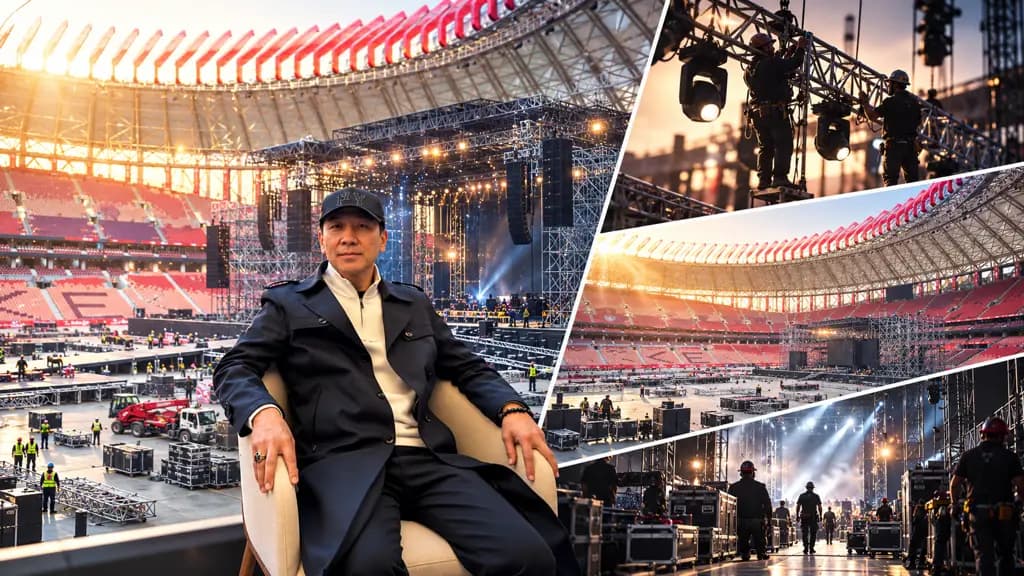
The scale of the upcoming concert can be gauged from the logistics alone. According to Islam Satarov, the concert equipment was transported to the country on several cargo aircraft. Part of the singer’s team has also already arrived in Bishkek.
According to Satarov, the artist’s requirements for the host side turned out to be quite practical and down-to-earth.
"She doesn’t have any extraordinary demands. The main requirements are security and good infrastructure. Her team takes care of everything else,” — he said.
The producer declined to disclose details of the singer’s technical and hospitality riders, citing confidentiality requirements.
For Kyrgyzstan, hosting an international show of this scale also represents an opportunity to gain valuable practical experience. Working with complex stage structures, advanced technical equipment, international logistics, and the requirements of a global tour can help lay the foundation for the development of the country’s own concert and live entertainment industry.
The concert’s marketing campaign also made a strong impression on the international team. According to Islam Satarov, the singer’s management took particular notice of the show’s unconventional promotional strategy, including eye-catching campaigns featuring participants dressed in bright pink costumes.
“The management team was surprised that such advertising had been allowed in our country. To them, it was a sign that there is democracy here and that people enjoy a certain degree of freedom,” — he says, recalling the impressions shared by his foreign colleagues.
According to the producer, such moments also help shape Kyrgyzstan’s international image. Visiting artists and their teams become familiar not only with the concert venue itself, but also with the country’s culture, social atmosphere, and the opportunities available for promoting their projects.
At the same time, Satarov emphasizes that he is not directly involved in organizing Shakira’s performance. Rather, he interacts with industry colleagues and provides support in a consulting capacity.
Beyond its branding and reputational impact, the concert also has a direct financial dimension for the government.
According to Islam Satarov, private investors cover the rental costs of Bishkek Arena, while the government generates additional revenue through the operation of the GovTicket ticketing platform.
“The investors cover the venue rental costs. For the first time in our country, the state-owned ticketing operator GovTicket is in operation. In addition, the government receives 10% of the ticket sales revenue through the platform,” — he said.
Thus, according to the producer, the government participates in the event’s commercial model not only as the owner of the infrastructure but also as a beneficiary of a share of the revenue generated from ticket sales.
As for the concert’s profitability, the expert refrains from making any definitive forecasts.
“I’ve been in this business for 20 years. Sometimes a project generates substantial profits, and sometimes it turns out to be a complete failure. But selling nearly 14,000 tickets on the very first day is already a sign that the project is a success,” — he said.
Ticket prices have perhaps become one of the most widely discussed aspects of the event. Standard seats are being sold for between 12,000 and 40,000 KGS, while certain premium categories are priced significantly higher.
With the official average monthly wage in Kyrgyzstan standing at 55,000 KGS, the most expensive standard ticket, priced at 40,000 KGS, costs less than a full month’s earnings, amounting to about 73% of that figure, while a 22,000 KGS ticket represents roughly 40% of the average monthly salary.
However, it is important to distinguish between two concepts: price and value.
A Shakira concert is a commercial service rather than a basic necessity. Its price reflects the costs of organizing the event, the limited number of available seats, and the audience’s willingness to pay for the opportunity to see a global superstar perform live.
For someone who grew up listening to Shakira’s music and has dreamed for years of attending one of her concerts, buying a ticket may well be a justified expense. For another concertgoer, however, that same amount may seem excessive.
However, the decision of whether such an expense is justified is ultimately a personal one.
Against this backdrop, on October 15, the ticketing platform GovTicket announced that it does not plan to reduce the official ticket prices for the concert. Prices have remained unchanged since sales began. At the same time, partners and other ticketing operators may independently run promotional campaigns and offer discounts to customers.
Calls have emerged on social media from fans seeking financial help to attend the concert, asking others to contribute money, lend them the necessary funds, or even sponsor the fulfillment of their musical dream.
Banks quickly took notice of this demand. Special offers, installment payment plans, and financing products linked to the Shakira concert soon began to appear on the market, with banks tailoring their promotions to capitalize on the growing interest in the event.
According to Islam Satarov, financial institutions primarily saw a marketing opportunity in the situation.
“It is beneficial for them to be part of a project like this. At the same time, they are providing people with additional opportunities to attend the concert,” — the producer said.
Thus, banks did not create the demand for concert tickets; rather, they responded to the audience’s existing desire to attend the singer’s performance.
At the same time, the debate over whether it is worth taking out a loan to attend a concert extends beyond the realm of financial literacy. The question of how much a person values the experience, and whether they are willing to forgo other expenses for it, is ultimately a philosophical one, touching on priorities, aspirations, and the value of personal experiences.
Islam Satarov believes that the successful staging of the concert could reshape how international artists view Kyrgyzstan.
“Shakira is paving the way for other global stars. Now, if organizers approach artists such as Lady Gaga, Bruno Mars, or BTS, they will already know that Kyrgyzstan is capable of hosting a world-class show,” — the producer said.
According to Satarov, having a successful track record of staging complex events is particularly important for international promoters. Shakira’s concert is expected to demonstrate that Kyrgyzstan has the capacity to provide the infrastructure, security, and organizational capabilities required to host world-class live performances.