

Published
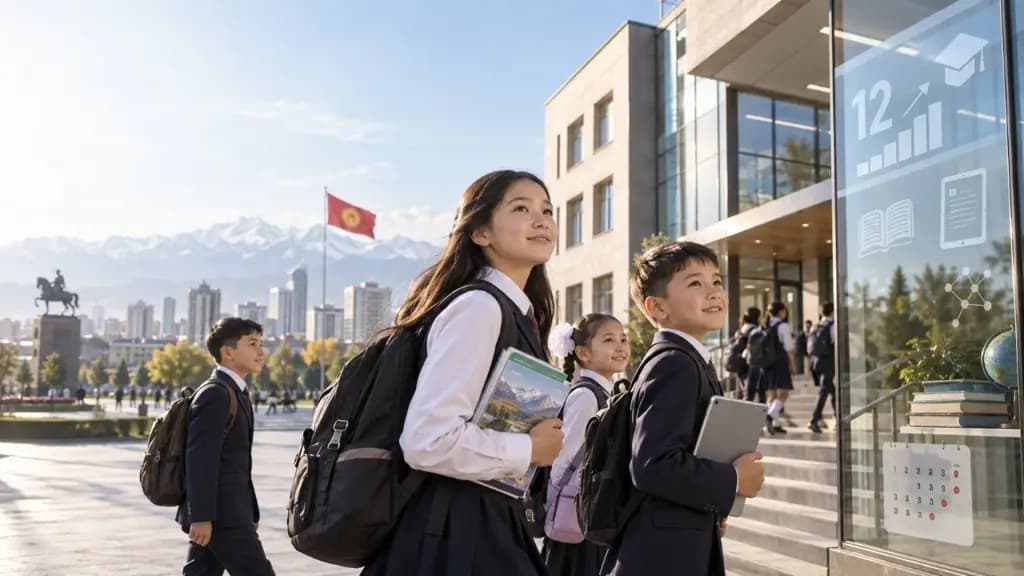
09/15/2026, 10:29Today, September 15, schoolchildren in Kyrgyzstan returned to their desks. This year, the start of classes was postponed by two weeks — instead of the usual September 1, children went to school in the middle of the month. The academic year will last until May 25, 2027.
The postponement is due to major national and international events held in Kyrgyzstan, including the celebration of the 35th anniversary of independence, the SCO summit, and the World Nomad Games. At the same time, the curriculum was not shortened: the missed days will be compensated with additional classes, including on Saturdays.
But the postponement of the school year’s start is far from the only change. Kyrgyzstan continues its transition to 12-year school education, with updated programs and learning materials for several grades, while eighth-graders will, for the first time, be able to explore different directions before choosing their specialization in high school.
Let’s break down what awaits schoolchildren and parents in the new academic year.
The first school day will take place today, September 15. For Bishkek schoolchildren, events dedicated to Knowledge Day and educational class hours are planned. A late start does not mean that the academic year will be shorter. To ensure that children cover the entire program, eight additional school days on Saturdays have been scheduled for schoolchildren in 6th–11th grades.
At the same time, not all Saturdays will become school days. Each school will determine the specific schedule independently, taking into account the organization of the learning process and coordinating it with parents and local education authorities.
For schoolchildren in 1st–5th grades, the five-day school week remains unchanged. In other words, younger pupils will continue studying from Monday to Friday, while schoolchildren in 6th–11th grades will have to attend classes on several Saturdays throughout the year.
The usual holiday schedule will also change.
In the 2026/2027 academic year, the main holidays will take place on the following dates:
Additionally, two weeks of extra rest are provided for first-graders, and one more week for second-graders. The exact dates of their holidays will be determined by district and city education authorities, taking into account climatic and sanitary-epidemiological conditions.
The main educational reform continues this academic year as well. Kyrgyzstan is gradually moving from an 11-year to a 12-year school education system.
In the 2026/2027 academic year, 3rd and 8th grades will directly transition to the new model.
Before this, 1st, 2nd, 5th and 7th grades had already transitioned to the 12-year model.
Therefore, this year the changes will affect several grade levels at once. Updated educational programs and teaching-methodological complexes will be used in 1st, 2nd, 3rd, 5th, 7th and 8th grades.
For the schoolchildren themselves, this primarily means new content in several subjects and different approaches to learning.
For third graders, new programs have been developed in eight subjects, while for eighth graders, in 15 subjects.
The transition is taking place gradually, so for some time schools will have classes following different programs simultaneously. In certain cases, one class may operate under the 11-year model, while a parallel class will already follow the 12-year model.
Under the 11-year model, classes continue in 3rd grade (schoolchildren born in 2017), as well as 4th, 9th, 10th and 11th grades. Meanwhile, the 12-year model has already been adopted by 1st, 2nd and 3rd grades (schoolchildren born in 2018).
For the current 2026/2027 academic year, 125 calendar-thematic plans and 40 methodological recommendations have been prepared for 3rd and 8th grades to support teachers during this transition period.
There is another particular feature: in this academic year, there will be no separate 6th grade parallel as usual. Some children will move directly from 5th grade to 7th grade, since they have already completed the 6th grade program within the integrated course "5+6". Eighth graders will be given the opportunity to explore different fields as part of pre-profile training.
One of the most notable innovations concerns eighth graders. Starting from the new academic year, pre-profile training will be introduced for them. Its purpose is not to force a child in 8th grade to decide what profession they will pursue in the future. On the contrary, schoolchildren are first encouraged to try different fields, discover what interests them and what they do best, and only then make a more informed choice of specialization in 10th grade.
The Kyrgyz Academy of Education has developed 15 pre-profile programs for 8th grade, some designed for 34 weeks and others for 68 weeks. They are structured for two hours per week over 34 weeks, totaling 68 hours. A shortened version of 34 hours is also available. Classes will be held in the format of elective clubs chosen by the schoolchildren themselves, depending on their abilities and interests. Each eighth grader is required to select no more than two programs if they are 34-hour courses, or one program if it is a 68-hour course.
Among the directions are mathematics and practical tasks, history, society, law and economics, humanities, health and life skills, physics and chemistry, arts and crafts, ecotourism, and others.
For example, schoolchildren are offered programs such as Mathematics in Life: How the World Works, Kyrgyz Citizen: History, Society, Law, Economics, Humanities Navigator: From Text to Meaning, Physics through Experiments, Chemistry in Life, Art Workshop: Artistic Creativity, Crafts and Music, and Culture of Ecotourism. At the same time, the focus is not only on theory. Classes are expected to include projects, practical assignments, case studies, digital technologies and artificial intelligence, meetings with professionals, research excursions, and teamwork.
In other words, eighth graders are not simply told about professions, but are given the opportunity to try different types of activities in practice.
Changes are gradually reaching the content of familiar school subjects as well.
In mathematics, a new content strand has been introduced — Data Analysis and Probability. It will be studied from 1st grade through 6th grade.
In the primary grades, children will begin working with tables, pictograms, and simple data. For example, first graders will learn to collect information and enter it into tables.
In 2nd grade, assignments will include data grouping and simple random experiments.
In 3rd grade, schoolchildren will work with graphs, charts, and the analysis of experimental results. 4th grade schoolchildren will be introduced to the concepts of "random", "possible", "impossible", "probable", and "unlikely".
In 5th grade, schoolchildren will analyze processes presented in graphs and also conduct experiments with a coin and a die.
In 6th grade, schoolchildren will engage in small-scale research, construct different types of charts, and assess the probability of random events.
Thus, mathematics will gradually go beyond solving only arithmetic problems — schoolchildren will be taught to work with information and draw conclusions based on data.
Updates have also affected the history curriculum. The history of Kyrgyzstan is now studied not separately, but in the context of global and Eurasian civilizational development.
The curriculum now places greater emphasis on historical thinking, research skills, working with digital information, civic identity, as well as understanding social and economic processes.
Schoolchildren will be taught not only to memorize dates and events, but also to work with maps and sources, analyze information, establish connections between historical processes, and make well‑reasoned civic decisions.
Changes have also affected geography. The updated curriculum now includes research‑cognitive, geo‑ecological, geo‑cultural, and geo‑informational‑digital directions.
Schoolchildren will work with maps, geographic information systems, and quantitative methods, as well as become familiar with environmental monitoring, climate scenarios, and green development projects.
For rural and small schools, distance and blended learning formats are provided.
Requirements for classroom equipment will also change. Among the necessary items are maps of Kyrgyzstan and the world, globes, atlases and outline maps, a computer and projector, meteorological instruments, collections of minerals and rocks, three‑dimensional relief models, and access to Google Earth.
The standard "Kyrgyz Language as a Second" has also been updated. It now separately highlights reading competence. The levels of learning, the content of the adaptation period in 1st grade, and the starting level A0 have been clarified. Systematic language acquisition is provided beginning from 2nd grade.
The reform affects not only schoolchildren. Teachers will also have to adapt to new programs and different curricula.
For teachers, 40 methodological recommendations by subject have been prepared for 3rd and 8th grades, which are transitioning to the new model. In addition, 125 calendar‑thematic plans have been developed.
The update of programs is accompanied by new teaching and learning complexes for 1st, 2nd, 3rd, 5th, 7th and 8th grades, which are participating in the next stage of the transition to 12‑year education.
For schools, it is important not only to publish new books, but also to ensure their timely delivery. As of August, the issue of providing educational literature included not only the printing of books, but also their distribution among schools and the provision of books in different languages of instruction.
For most children, September 15 will begin quite familiarly: an assembly or homeroom session, the first lessons, new schedules, and the usual school routine. But afterwards, the academic year will differ from previous ones.
Schoolchildren of 1st, 2nd, 3rd, 5th, 7th, and 8th grades, who have moved or are moving to the 12‑year model, are studying under updated programs. Schoolchildren will begin learning according to the updated programs, while some grades will continue the transition to the 12‑year model. Pupils of 6th–11th grades will have to spend eight additional Saturdays at school. The holiday schedule will also change.
For 8th grade schoolchildren, a new format of classes will appear — pre‑profile training. They will be able to try different directions and gain more information about their interests and abilities before choosing a specialization in high school.
Changes in individual subjects will gradually shift the focus from simple memorization of information to its analysis and practical application: in mathematics — through working with data and probability, in history — through research and digital sources, in geography — through GIS and ecological projects, and in Kyrgyz language — through the development of reading competence.
Thus, the new academic year will become another stage in the major reform of school education. For parents, the most noticeable changes are the new calendar, additional Saturdays, and the gradual transition to the 12‑year system. For schoolchildren themselves, it means new programs, learning materials, and, starting from 8th grade, the opportunity to explore different directions in advance.
Stay updated! Subscribe to our Telegram.