

Published
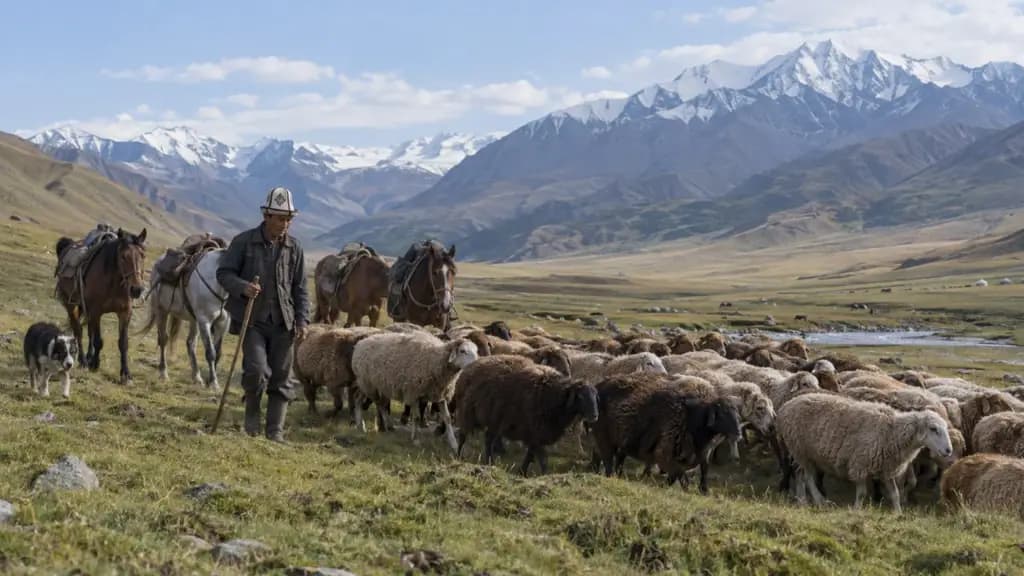
09/10/2026, 14:30For a livestock farmer, pasture is not just a plot of land where cattle graze. It is fodder, family income, and the opportunity to keep the farm running year after year. The timing of when to move animals onto a particular plot, when to transfer them further, where to leave land for recovery, and where to find water determines not only the condition of the pasture but also the productivity of the farm itself.
In Kyrgyzstan, this system is facing increasing pressure. Climate change, droughts, the growth of livestock numbers, and excessive use of pastures near villages are gradually reducing land productivity.
The problem has not only an environmental but also an economic dimension. The less fodder the pasture provides, the more the farmer has to purchase. The cost of keeping livestock rises, and along with it, the cost of producing meat and milk.
Myktybek Kalandarov, Head of the Department of Livestock and Veterinary Services at the Ministry of Water Resources, Agriculture and Processing Industry, says that in 2023 the area of degraded land was estimated at around 139,000 hectares. At the same time, the Ministry itself acknowledges that this figure requires clarification: a repeat monitoring is currently underway, since some plots previously classified as degraded may not correspond to this status.
Pasture degradation manifests in different ways. In some areas, grass becomes scarce, while others become overgrown with caragana, shrubs, thorns, and weeds. Another problem arises where livestock are constantly grazed on the same plot — in winter, spring, and summer.
Vegetation does not have time to recover, the soil gradually loses productivity, and the livestock farmer is faced with the need to seek additional sources of fodder. Thus, an environmental problem turns into an economic one.
Kyrgyz livestock production largely depends on natural pastures. When the land provides less fodder, the deficit has to be compensated with purchased feed. This year, according to the Ministry, the average cost of feed was 250–300 KGS, and in some cases reached 450–500 KGS. Under favorable weather conditions, no serious feed shortage was observed this year. However, the situation itself remains dependent on the climate.
For the farmer, this means a simple economic chain: less natural fodder — higher costs for keeping livestock.
At the same time, the same cow or sheep may require more resources but not necessarily yield more output.
The productivity of the current livestock population remains one of the sector’s challenges. The Ministry notes that meat and milk production from pasture-based livestock does not meet current demand. For comparison, in pedigree farms the productivity of individual animals in terms of milk can reach 6–7 thousand liters.
Thus, the issue lies not only in the number of animals. Equally important are the quality of the livestock, the availability of feed, and the productivity of each animal.
Traditional pasture-based livestock farming in Kyrgyzstan has historically been built on moving herds between pastures depending on the season. This system allowed for distributing the load on the land and utilizing different areas throughout the year.
But when pastures near settlements are used too intensively, the balance is disrupted.
This is why pasture preservation is linked not only to land restoration, but also to the way livestock farming itself is organized.
Knowledge of where and when to graze livestock, when to let a plot rest, how to use seasonal pastures, and where to provide animals with water becomes an economic resource.
At the same time, traditional knowledge today needs to be combined with modern approaches — monitoring land conditions, planning the load, developing the fodder base, and improving livestock breeds.
In this system, a pasture is not merely a natural resource or a production base. For pasture-based livestock farmers, it is part of their household economy, lifestyle, and knowledge passed down through generations. Preserving this knowledge becomes just as important as restoring the land itself.
In the context of climate change, the future of pasture-based livestock farming depends on the ability to combine traditional experience with modern resource management methods. The more efficiently each hectare is used, the less need there is to increase pressure on the land and livestock numbers to boost production.
At first glance, the solution may seem obvious: if the country needs more meat and milk, the livestock population should be increased.
However, for the pasture-based system, such logic can only work up to a certain limit.
The more animals are concentrated on one area, the greater the pressure on the grass cover. With excessive grazing, plants do not have time to recover, and the fodder base diminishes.
The Ministry directly associates degradation with the large number of livestock and excessive pressure on pastures. Therefore, starting from 2027, it is proposed to place greater emphasis on stall-based animal husbandry.
This does not mean a complete abandonment of pasture-based livestock farming. Rather, it is about finding a balance in which animal productivity increases while pressure on the land decreases.
With stall-based husbandry, the farmer gains more opportunities to control the animals’ diet, use silage and other feeds, carry out vaccination, artificial insemination, and improve breed characteristics.
The economic meaning of this approach is to shift from the model "more animals — more production" to the model "a more productive animal — more production with less pressure on the land".
Special attention is given to breeding farms. Currently, Kyrgyzstan has 232 breeding farms. Among the recommended breeds are Aberdeen Angus, Brown Swiss, and Simmental. At the same time, it is important to select breeds adapted to local climatic and natural conditions.
For food security, this is of fundamental importance. If the productivity of a single animal is increased, the country will potentially not need to proportionally expand the livestock population.
This means there is an opportunity to simultaneously produce more output and preserve the very resource on which livestock farming depends — the pasture.
The state already has several tools for pasture restoration. One of them is grass seeding. To improve one hectare, it is planned to use 6–10 kilograms of pasture seeds. The agency has purchased 186 tons of seeds.
If the stated norm is recalculated, this volume would theoretically be sufficient for about 18.6–31 thousand hectares, depending on the seeding rate.
After that, the plot must be protected from grazing for about two years so that the plants have time to take root and produce seeds. For protection, wire fences or electric shepherds can be used. In 2024, this approach was applied to areas of up to 1,000 hectares and showed good results.
Another tool is pasture rest. Each year, about 400 thousand hectares are left unused so that the grass can recover and form a seed reserve.
However, such a solution has an economic cost. While the plot is being restored, livestock must receive feed from other sources or use alternative pastures.
Another method is the application of organic fertilizers. Last year, in the Shumkar aiyl okmotu of Talas province, the cost of fertilizing one hectare was estimated at about 400 KGS. It was proposed to use drones for application.
Thus, the real cost of pasture restoration is not limited to seeds or fertilizers. It also includes fencing, protection, temporary withdrawal from grazing, and additional expenses for animal feed.
The problem requires constant expenditures. According to the agency, about 50 million KGS are allocated annually from the budget for pasture improvement.
But the question arises: are these funds sufficient if the pressure that leads to degradation is simultaneously maintained?
If the state restores one plot while overgrazing continues on another, funds have to be redirected again to eliminate the consequences.
Therefore, pasture management becomes no less important than the financing of their restoration itself.
In Kyrgyzstan, annual and five-year pasture management plans are being developed. They provide for land rest, seed sowing, road and bridge repairs, and the creation of watering places.
Payments for pasture use are also established on a per-head basis. The collected funds are to be directed toward the improvement of the respective territories.
This shows that the pasture is gradually becoming an asset that must be managed as rationally as any other production resource.
Another factor that makes the system more vulnerable is climate change.
According to the agency, a significant part of degraded areas in Kyrgyzstan is linked to climate change. This is especially true for Batken, Jalal-Abad, and Osh provinces. Additional factors include the increase in livestock numbers on nearby pastures and the misuse of land.
Rising temperatures and droughts mean that the fodder situation can vary greatly from one year to another.
The current season has shown the reverse side of this dependence: thanks to the rains, the condition of many pastures is assessed as good, and no serious shortage of fodder is observed.
But a year with good rainfall does not guarantee the same result in the next season.
For a livestock farmer, this means the need to be prepared for changing conditions: to have a reserve of fodder, to distribute the load on pastures, and not to depend on a single source of feed for animals.
The link between the state of pastures and the price of meat or milk is not expressed by a simple formula: Эone hectare degraded — the product became more expensive by a certain number of somsЭ.
The final cost is influenced by the price of fodder, veterinary expenses, fuel, transportation, the cost of young stock, labor, and the trade markup.
But the pasture is part of the production chain.
If the natural fodder base decreases, the farmer has to buy more feed. If at the same time its price rises, keeping an animal becomes more expensive.
And if livestock productivity remains low, the additional costs are spread over a relatively small volume of meat or milk produced.
Therefore, pasture degradation can be regarded as a hidden factor in the rising cost of livestock production.
The main issue lies not only in how to restore already degraded land. It is important to prevent it from losing productivity again.
For this, not only budget expenditures are necessary, but also a change in the approach to livestock farming itself.
Pasture rest, proper load distribution, development of fodder crops, improvement of breeds, and increasing animal productivity make it possible to solve two tasks at once — preserving the land and producing more output. And here, the role of pasture livestock farmers is especially important.
Their knowledge — when to move the herd to another plot, how to account for seasonality, where to find water, how not to overload the land — has been formed over generations. Today this knowledge is becoming especially valuable, because climatic conditions are changing and the pressure on pastures is increasing.
The future of pasture-based livestock farming will most likely be built on a combination of this experience with modern technologies and more precise resource management.
Pasture is not an endless free resource. It is a production base on which the incomes of rural families, the cost of fodder, the volume of meat and milk production, and the food security of the country depend.
Therefore, to preserve pastures means to preserve not only the fodder base, but also the opportunity for rural families to continue their work. And investments in sustainable pasture management simultaneously become investments in land, people, and the food security of the country.
Thus, increasing livestock productivity means enabling animals to produce more without endlessly increasing the pressure on the land.
This is the main challenge for Kyrgyzstan: to preserve the knowledge and way of life of pasture livestock farmers, adapt them to new climatic conditions, and ensure that pastures remain a source of life not only today, but also for the next generation.
Stay updated! Subscribe to our Telegram.