

Published
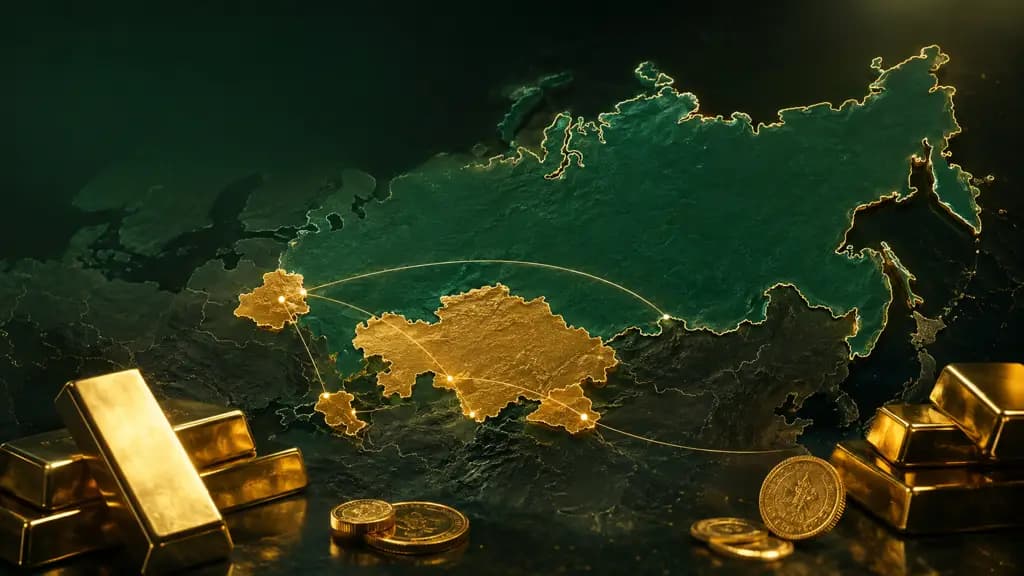
08/06/2026, 11:26According to data from the World Gold Council, the international reserves of the five countries of the Eurasian Economic Union contained around 2,760 tonnes of monetary gold at the end of the first quarter of 2026. Over 83 per cent of the union’s total reserves are concentrated in Russia.
This refers to gold held in the international reserves of central banks, not to geological reserves in mineral deposits.
The gold reserves of the EAEU countries are distributed as follows:
According to the World Gold Council, Armenia’s international reserves do not include monetary gold. At the end of the first quarter of 2026, the country’s foreign exchange reserves stood at $5,542.3 million.
Russia thus accounts for 83.5 per cent of the EAEU’s total gold reserves. Kazakhstan accounts for a further 12.8 per cent. Belarus’s share is around 2 per cent, and Kyrgyzstan’s is 1.7 per cent.
Kyrgyzstan ranks fourth in the EAEU in terms of monetary gold holdings. However, the gap with Belarus has narrowed to 6.05 tonnes.
During the first quarter of 2026, Kyrgyzstan’s gold reserves increased from 45.87 to 47.81 tonnes. This is the highest figure in the history of available records. Consequently, the increase amounted to 1.94 tonnes, or 4.2 per cent.
During the quarter, the volume fluctuated in different directions. In January, the National Bank reduced its gold reserves by approximately 1 tonne, but subsequently resumed purchases. As a result, Kyrgyzstan remained a net buyer of gold over the three-month period.
Kyrgyzstan’s current reserves have already reached almost 89 per cent of Belarus’s level. If this trend continues, the country could rise to third place within the EAEU.
EAEU countries pursued different strategies in the first quarter.
Kazakhstan became the largest buyer within the union. The country’s National Bank purchased around 12.55 tonnes of gold, increasing its reserves to 353.59 tonnes.
Kyrgyzstan added 1.94 tonnes. Belarus’s reserves remained virtually unchanged at 53.86 tonnes.
Russia, by contrast, sold around 21.77 tonnes. This was one of the largest reductions in gold reserves among the world’s central banks during the quarter.
Purchases by Kazakhstan and Kyrgyzstan were unable to fully offset Russia’s sales. As a result, the combined gold reserves of the EAEU countries fell by approximately 7 tonnes between January and March.
Excluding Russia, the remaining four member states hold only 455.26 tonnes of gold. Almost 78 per cent of this total belongs to Kazakhstan.
Outside the EAEU, Poland was the largest buyer in the first quarter, increasing its reserves by approximately 31.43 tonnes. Uzbekistan purchased around 25.19 tonnes, whilst China acquired 7.15 tonnes.
Other buyers included the Czech Republic and Malaysia – around 5 tonnes each – as well as Guatemala, Cambodia and Indonesia – around 2 tonnes each.
Turkey was the largest seller, reducing its official gold reserves by approximately 79.5 tonnes. A significant proportion of the transactions were related to foreign exchange liquidity management and the use of gold swaps.
Azerbaijan’s State Oil Fund sold around 22 tonnes — almost as much as Russia.
Initially, the World Gold Council estimated central banks’ net purchases in the first quarter at 244 tonnes. Subsequently, some of the transactions were reclassified from official sector deals to the over-the-counter segment.
Following the revision, the estimate of net demand from central banks fell to 57 tonnes — the weakest first-quarter result in more than 15 years.