

Published
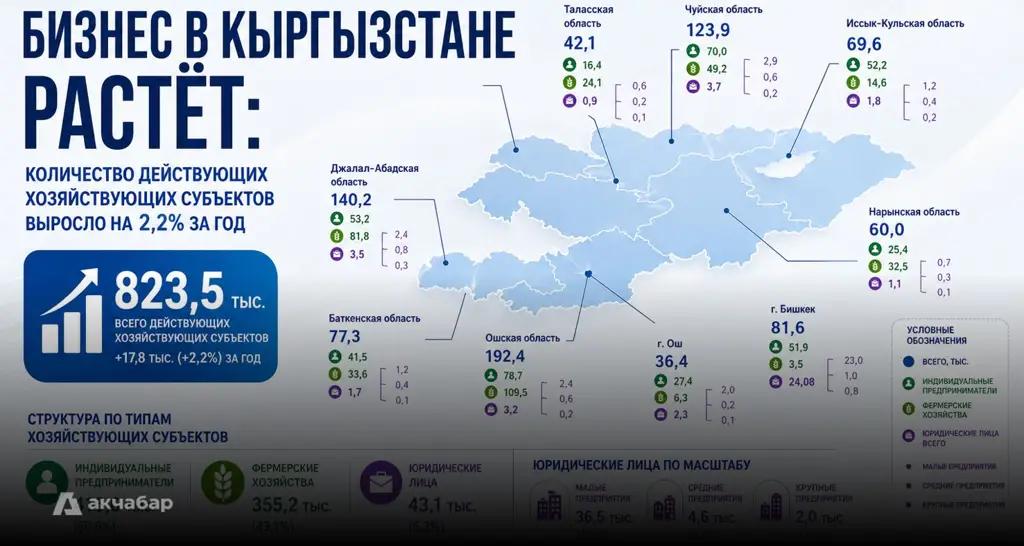
04/29/2026, 11:05As of April 1, 2026, the number of active business entities in Kyrgyzstan reached 823,500. This represents an increase of 17,800, or 2.2%, over the past year. The growth rate was higher the previous year—4.6%.
The statistics show not just an increase in the number of businesses and entrepreneurs, but a gradual shift in the structure of the economy—both in terms of types of economic entities and types of economic activity.
The main growth was driven by individual entrepreneurs. Their number rose from 399,800 to 416,600, and their share of the total number of economic entities exceeded half for the first time—50.6% compared to 49.6% a year earlier. This makes individual businesses not just the largest category in the country’s economy, but the dominant one.
Against this backdrop, farms, on the contrary, declined slightly—from 357,700 to 355,200—and their share fell from 44.2% to 43.1%.
At the same time, the number of legal entities grew—from 39,600 to 43,100, or by nearly 8.8%. Their share increased from 4.9% to 5.4%, which may indicate a gradual expansion of the more formalized business segment.
Growth within the corporate sector was driven primarily by small enterprises, whose number increased from 33,000 to 36,500. The number of medium-sized companies grew slightly, while the number of large companies actually decreased slightly.
In fact, the business structure is becoming even more oriented toward small businesses.
This is also confirmed by sectoral dynamics.
Although agriculture remains the largest sector in terms of the number of entities—476,300, or 59.1% of all active business entities—growth here amounted to only 0.7%.
In contrast, the market and service sectors showed higher growth rates.
Construction emerged as one of the leaders—the number of entities grew by 12.6%, to 10,200.
Retail trade and automobile repair saw even stronger growth—by 16.2%, to 157,800 entities. This is now the second-largest sector of the economy after agriculture.
The information and communications sector grew by 13.8%, education by 15.4%, and administrative and support services by 13.5%.
Hotels and restaurants, financial services, real estate, and manufacturing also showed positive growth.
However, not all sectors grew. For instance, the number of entities in public administration decreased by 2.8%, and in other service activities—by 1%.
It can be concluded that the growth in new market participants is increasingly driven by trade, construction, and the service economy, rather than traditional sectors.
Regionally, the largest concentration of businesses remains in the Osh region (192,400 entities), followed by the Jalal-Abad region (140,200) and the Chui region (123,900).
At the same time, the role of the private sector is growing. The number of privately owned entities has risen to 811,300, and their share has reached 98.5%.