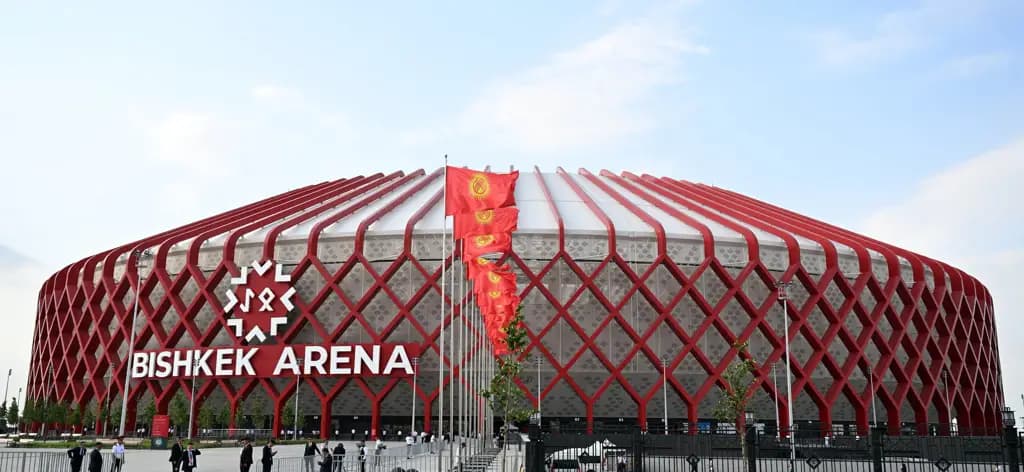


Published
09/08/2026, 10:41The estimated cost of constructing the ‘Bishkek Arena’ stadium was $386 million. Previous reports suggesting that the project cost $60 million are untrue, according to the spokesperson for the President of Kyrgyzstan, Askat Alagozov. However, the actual expenditure is yet to be verified by a special commission comprising the Chamber of Accounts and other state bodies.
According to Alagozov, it had previously not been possible to obtain full information on the cost of the project, as the builders and staff involved in the project were busy preparing for the SCO summit and the 6th World Nomad Games.
The initial plan was to build a standard stadium with a capacity of 30,000–35,000 spectators. It was at this stage that Kamchybek Tashiev, Chairman of the State Committee for National Security, cited an estimated cost of between $60–70 million.
Subsequently, President Sadyr Zhaparov instructed that the project be completely redesigned. Instead of a conventional sports venue, it was decided to construct a multi-purpose complex in the shape of a Kyrgyz yurt, incorporating retail and entertainment facilities.
As Alagozov explained, the commercial infrastructure is intended to generate revenue for the stadium itself, so that the costs of its upkeep, operation and staff salaries do not fall on the state budget.
‘Bishkek Arena’ is built on a site covering approximately 20 hectares. The total floor area of the building is 194,248 square metres. The structure has a diameter of 280 metres and a height of 70 metres. The building has eight storeys.
The stadium has a capacity of 51,252 spectators. According to the press secretary, the increase in capacity was partly due to the requirements for hosting world-class international competitions.
If the stated estimated cost is divided by the total area of the complex, the construction of one square metre cost approximately $1,990.
The total area of the shopping centre inside ‘Bishkek Arena’ is 35,916 square metres — around 18.5 per cent of the complex’s total area.
The commercial facilities include:
Alagozov stated that, thanks to these facilities, the stadium will be able to recoup its costs and generate revenue in the future. According to him, applications are already being received to host paid events and concerts.
However, specific calculations regarding projected revenue, annual maintenance costs and the expected payback period have not yet been provided.
To justify the project’s cost, Alagozov cited examples of large stadiums built in other countries. In particular, the cost of Allegiant Stadium in the US was $1.9 billion, Tottenham Hotspur Stadium in the UK — $1.33 billion, and the National Stadium in Singapore — $1.31 billion.
The 82,000-seat Jakarta International Stadium was estimated at approximately $600 million, whilst the 50,000-seat Stade du Sénégal was estimated at $420 million.
He also pointed out that the cost of major projects often increases during construction. For example, the budget for AT&T Stadium rose from an initial $650 million to $1.15 billion, whilst the cost of SoFi Stadium rose from $2.6 billion to over $5 billion.
Among the factors contributing to rising construction costs, Askat Alagozov cited rising prices for steel and concrete, logistical costs, labour costs, engineering systems, commercial areas, inflation and a global shortage of building materials.
For Kyrgyzstan, the additional costs are linked to seismic resistance requirements, the need to account for snow loads and winter temperatures, the installation of heating systems and the use of reinforced steel structures.
Despite the announced estimated cost of $386 million, a final assessment of the actual expenditure is to be carried out by a special commission set up on the President’s instructions.
Representatives of the Audit Office and other authorised bodies will take part in the audit. The commission is to determine whether all the construction materials purchased were used, whether workers’ wages were paid in full, and whether any embezzlement of funds took place.