


Published
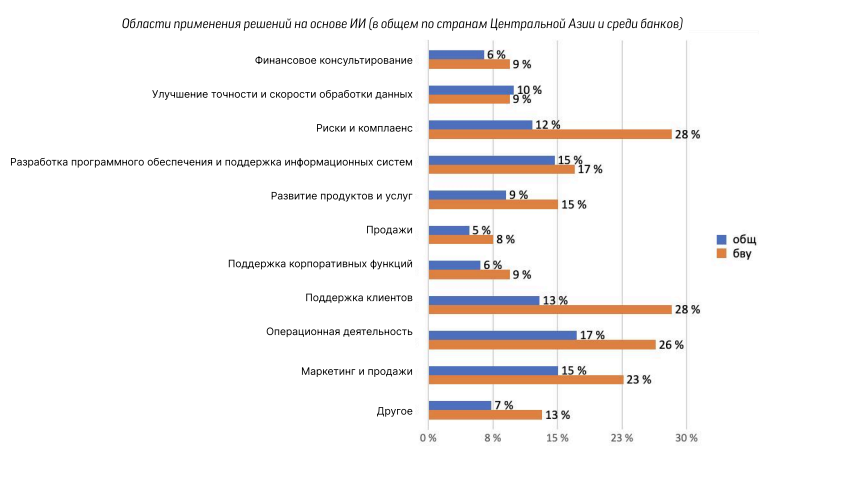
02/23/2026, 12:46Artificial intelligence in the banking sector of Central Asia is increasingly being used in areas where business stability and regulatory compliance are at stake. Already, 28% or 15 of the banks surveyed in the region use AI in risk management and compliance—one of the highest rates among all areas of implementation. This is stated in the analytical report “Artificial Intelligence in the Financial Markets of Central Asia,” which covered 53 banks in Kazakhstan, Kyrgyzstan, and Tajikistan.
In fact, one in three banks trusts algorithms to assess credit risks, monitor operations, and control compliance with regulations. The same level of AI penetration has been recorded in customer support (28%), which highlights the dual focus of banks: security and service.
This is followed by operational activities, with 26% of banks using AI to optimize internal processes. The technology is used in marketing and sales in 23% of cases, and in software development and IT system support in 17%.
Commercial banks demonstrate a more pronounced orientation towards digital tools. Thus, while the overall indicator of AI use in various areas across three countries — Kyrgyzstan, Kazakhstan, and Tajikistan — does not exceed 17% (the highest indicator in companies' operational activities), in banks it is 1.65 times higher.
And in the risk and compliance segment, their indicators are more than twice the average market values for Central Asia. A similar dynamic is observed in customer support. At the same time, commercial banks are not inferior to the market in any of the areas.
Thus, the largest players in the banking sector view AI not as an auxiliary tool, but as part of their strategic management system. According to the results of the study, it is already being established in functions that directly affect financial stability and trust in the system.