

Published
08/06/2026, 18:00Around 97 per cent of trade between Kyrgyzstan and Russia is already conducted in national currencies. The parties now intend to extend this practice to investment cooperation and the joint financing of major projects.
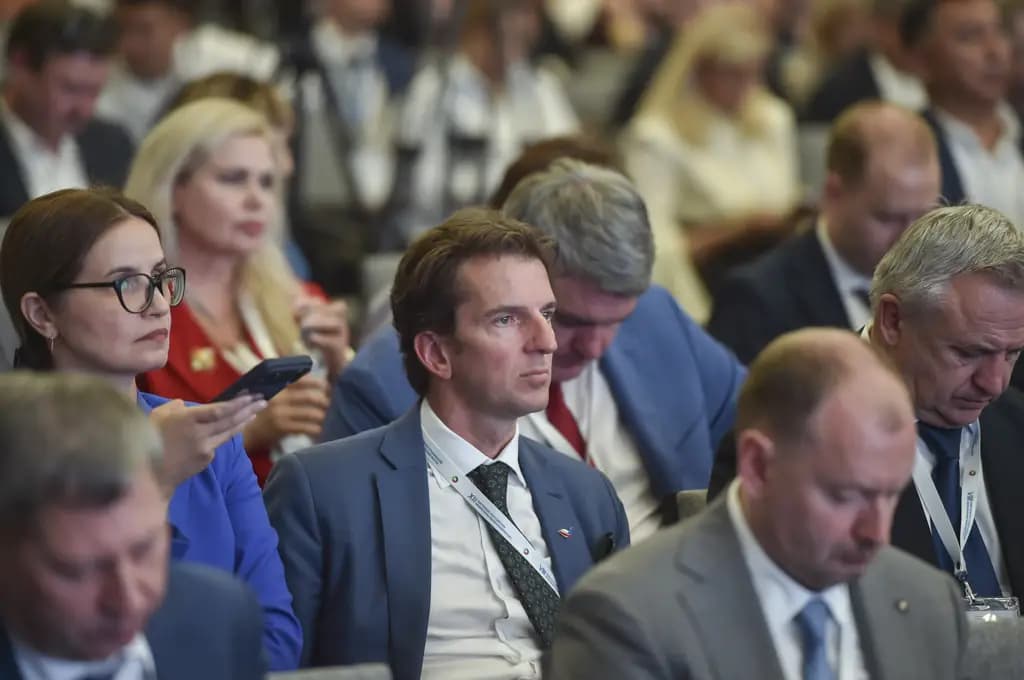
This was announced by participants at the session ‘Financial Architecture of the Kyrgyz Republic and the Russian Federation: New Financing Instruments’, held as part of the 8th Kyrgyz-Russian Economic Forum in Issyk-Kul.
Nikita Gusakov, Senior Vice-President of the Russian Export Centre and Chief Executive Officer of ESKAR JSC, noted that the two countries have significantly reduced their dependence on the US dollar in mutual settlements.
“Around 97 per cent of trade is already conducted in local currencies. We have stopped thinking exclusively in dollars. The rouble dominates, but the KGS is also actively used, and this is gradually extending to investment activity,” he said.
The next stage, he said, should be to pool the capabilities of financial institutions in Kyrgyzstan and Russia to implement major projects that are already in the preparatory stage.
One such mechanism could be blended finance. This involves the simultaneous use of loans, government guarantees, insurance cover and other instruments that allow risks to be shared among project participants.
Sergey Storchak, a senior banker at the state development corporation ‘VEB.RF’, compared this mechanism to combining several components into a single financial structure.
“Blending is when different ingredients are combined to form a single mass that does not fall apart or split,” he explained.
Nurbek Akzholov, Deputy Minister of Finance of Kyrgyzstan, emphasised that the state should not seek to replace banks and private investors. Its role is to reduce risks and the cost of financing.
“The state’s role is not to replace banks or private investors, but to reduce risks in order to attract direct private investment and make financing more affordable,” he noted.
According to Akzholov, to support business, Kyrgyzstan is developing state guarantees and sureties, budgetary lending and interest rate subsidies. These instruments should make it easier to attract private capital to investment projects.